The ping of a Slack notification announcing a new martech tool integration is now as common in marketing departments as the hum of servers is in an IT data center.
Marketing and creative departments have, in effect, become miniature IT operations. Yet, while IT has spent decades honing disciplines around governance, service ownership, and operational management, marketing teams often persist with a fragmented, project-centric approach to their increasingly complex technology stacks.
Today’s enterprise marketing and creative environments aren’t just collections of software; they are living, breathing operating systems. These systems are burdened by long and ever-expanding lists of integrated marketing technology (martech) solutions.
When production hiccups, the knee-jerk reaction is often to add another layer of automation. If briefing devolves into chaos, a workflow tool is connected. Reporting weakens? Another analytics platform is plugged in. Scaling becomes a pain point? Cue the AI solutions.
Each individual fix might seem logical, addressing an immediate, pressing pain. But the critical oversight is the failure to consider the broader ecosystem into which these tools are being inserted. Without adopting IT’s established methodologies for managing complex technology, marketing risks creating dysfunctional, unmanageable operating environments.
Marketing’s Capabilities Outpaced Its Operational Maturity
Marketing teams have acquired technology at a blistering pace, far outstripping the development of coherent operational disciplines. In simpler, less interdependent times, a fragmented martech strategy might have sufficed. Those days are long gone.
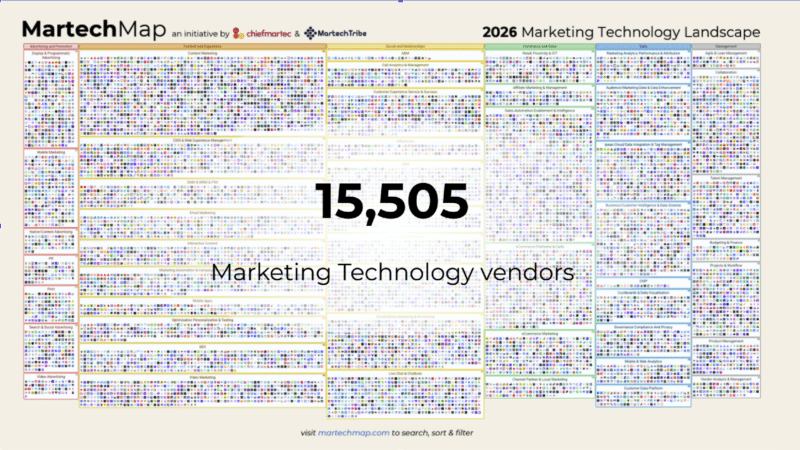
The martech landscape has exploded over the last 15 years, morphing from hundreds to tens of thousands of solutions. It’s no longer a curated list of software options but a sprawling, often chaotic ecosystem of vendor platforms, modules, connectors, APIs, and custom-built integrations.
If the primary challenge for marketing were simply access to capability, then the expanding stack should logically boost efficiency. Instead, efficiency suffers because capability continues to outpace an organization’s ability to evolve its management practices.
Most martech stacks are already overloaded. The addition of AI and automation only exacerbates this problem. Consequently, the foremost hurdle for achieving consistent creative output isn’t the availability of tools, but the effective management of a complex and perpetually shifting technology environment.
Why Martech Needs More Than Just Project Management
Marketing organizations persist in viewing and funding technology through a project-based lens. The typical cycle involves vendor selection, tool implementation, content migration, workflow rollout, user training, and a triumphant launch, followed by project closure.
Projects, by their nature, end. Services, however, do not.
Ownership Demands Extend Beyond Initial Implementation
A live marketing or creative platform carries immediate and ongoing operational responsibilities. Someone must own the intake process, manage user roles and permissions, and safeguard template integrity. There’s a constant need to maintain metadata standards, define support structures, prioritize feature backlogs, meticulously document changes, and ensure the platform remains aligned with evolving use cases—all without letting it devolve into unmanageable sprawl.
When any of these elements falter, the entire environment begins to drift:
- Local teams start building unauthorized workarounds.
- User trust erodes.
- Reporting becomes increasingly unreliable.
- Crucial integrations grow brittle.
Each workaround introduces a new exception to the rule. Within a year, the platform technically exists, the licenses are renewed, but the system no longer functions as a controlled, predictable environment.
Marketing Requires a Service Mindset, Not a Project Mindset
Too many organizations prematurely declare martech implementations a success. The configuration is complete, the launch has occurred, and training sessions are finished. However, the foundational conditions for sustained, effective operation remain absent.
A martech platform is truly ready for productive use only when clear ownership, strong governance, defined intake processes, reliable support, comprehensive documentation, disciplined release management, unambiguous role clarity, and measurable success metrics are firmly established.
This shift necessitates a re-evaluation of funding and staffing models. A project-centric mindset prioritizes implementation roles: program leads, migration specialists, vendor consultants, rollout coordinators, and launch-focused trainers. Conversely, a service mindset demands enduring, dedicated roles such as: platform owners, service owners, support leads, governance specialists, creative technologists, creative engineers, adoption managers, and platform directors.
Operational obligations commence long before launch and continue through every daily action. The fundamental question isn’t if the environment will need ongoing management, but who will be responsible for ensuring it runs smoothly day in and day out.
What IT Can Teach Marketing About Managing Tech Stacks
Operational discipline is the bedrock of IT culture, serving as the bulwark against ecosystem implosion. IT teams inherently understand that technology’s true value isn’t solely derived from its initial implementation. Ongoing maintenance and rigorous management are equally, if not more, critical for consistent, predictable operation—particularly as martech stacks reach enterprise-level integration and complexity.
IT approaches the entire ecosystem as a live service, a continuous operational challenge rather than a series of discrete projects. This perspective fosters accountability and ensures that technological investments deliver sustained value.
The most critical challenge for consistent creative outputs has become running a complex and changing technology environment.
This is where marketing must learn. The proliferation of tools, fueled by the promise of enhanced efficiency or creativity, has inadvertently created significant operational overhead. Without the structured approach that IT has long practiced, marketing teams will continue to find their sophisticated toolkits becoming more of a burden than a benefit.
Consider the parallels to IT incident management. When a server goes down or a critical application fails, IT doesn’t start a new project to fix it. They execute established incident response protocols, leveraging documented procedures, pre-defined roles, and continuous monitoring systems. This reactive agility, built on proactive operational planning, is precisely what martech environments now require.
The impulse to “just add another tool” to solve a marketing problem is a symptom of a deeper malady: a lack of operational maturity. IT’s approach—emphasizing service ownership, lifecycle management, and continuous improvement—is not just best practice; it’s a necessity for any department running complex technology at scale.
Marketing leaders must recognize that their martech stack is not a discrete project to be launched and forgotten. It is an ongoing operational service that demands dedicated resources, clear governance, and a commitment to continuous management. The future of effective marketing hinges on this critical shift in perspective and practice.
🧬 Related Insights
- Read more: AI Agents: 84% Stuck in Pilot Hell
- Read more: Retail Media Networks Face Existential Threat From AI Shopping Agents
Frequently Asked Questions
What does ‘operational discipline’ mean for marketing?
It means treating martech not as a series of individual projects, but as a continuous service. This includes establishing clear ownership, strong governance, defined support processes, ongoing maintenance, and proactive management of the entire technology ecosystem.
Will this replace the need for new marketing technology?
No, but it will change how new technology is integrated and managed. A focus on operational discipline ensures that new tools enhance, rather than complicate, the existing environment, and that their value is sustained over time.
How can marketing teams start adopting an IT service model?
Begin by identifying critical operational gaps, such as lack of clear ownership or defined support processes. Then, advocate for dedicated roles and resources that focus on long-term platform health and user support, mirroring IT’s service management frameworks.