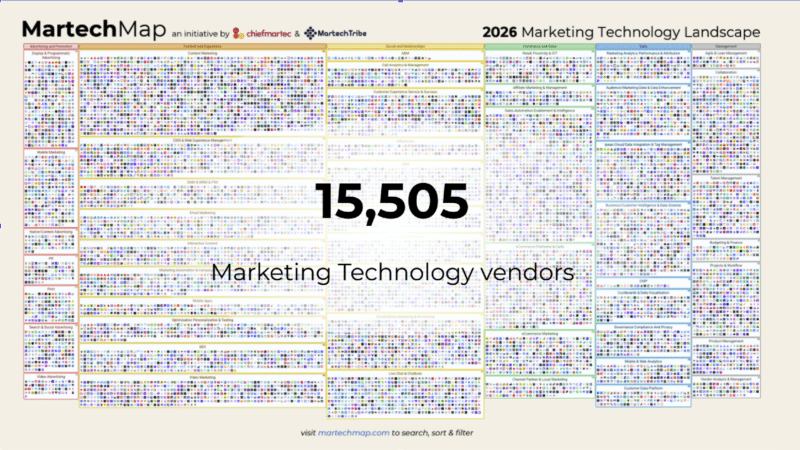
0.7%. That’s the headline growth for the marketing technology landscape in 2026, inching from 15,384 to 15,505 tools. At first blush, it sounds like a flatline, a tired industry gasping its last. But numbers, especially in tech, are rarely that simple. Beneath that tepid percentage, a violent churn occurred: nearly 1,500 new tools entered the fray, while more than 1,300 evaporated. This isn’t stagnation; it’s purgative renewal.
For years, we’ve watched the martech landscape not for its final tally—a vanity metric for some—but as a unique vantage point, a high-altitude scan revealing the subtle, seismic shifts happening beneath the surface. What 2026 shows us is brutally clear: Peak Martech was a fantasy. We’re not in a phase of accumulation anymore. We’ve entered Martech’s Darwinian period.
The era of haphazardly piling on new software is giving way to a relentless cycle of replacement. Why? Because the very bedrock of value creation is shifting. SaaS platforms, once the crown jewels of differentiation, are transforming into mere infrastructure. Think of them as the operating systems, the stable, structured layers that keep things humming—systems of record, workflow engines, integration hubs. The real action, the actual value, is now happening on top of that foundation.
And that’s where AI enters the picture. Where traditional SaaS operates on rigid rules and predefined logic, AI dances with language, context, and probability. It doesn’t just execute workflows; it interprets, it decides, it adapts. It’s like adding sound to a silent film; the framework remains, but the entire experience—the value—is fundamentally transformed.
This rewiring means the focus isn’t on assembling the perfect toolkit anymore. It’s about enabling the right outcomes. The landscape isn’t flat; it’s being fundamentally reconfigured.
Is AI Really the New Value Layer?
If the landscape is being rewired, the most immediate impact will be felt in how companies generate customer value. Nowhere is this more apparent than in the realm of personalization. For years, personalization meant rules-based segmentation, predefined workflows, and trigger-happy campaigns. If a customer fit a certain profile, they got a specific, pre-baked experience. This model worked when customer journeys were linear and channels were neatly compartmentalized.
That world? It’s dissolving.
Retrieving structured data like a customer’s age or city probabilistically might not make intuitive sense in an AI-driven world, but SaaS remains indispensable as the foundational layer for such data. However, as AI ascends to become the value layer, personalization transcends mere journey configuration. It morphs into a continuous, real-time interpretation of context, driving adaptive responses. The shift is subtle yet profound: from designing experiences upfront to dynamically generating them, all underpinned by a strong SaaS and data infrastructure.
This isn’t an iterative improvement. It’s a seismic paradigm shift, turning the tables on how we think about customer engagement:
OLD (SaaS Era) | NEW (AI Era) | | Rule-based | Context-based | | Deterministic | Probabilistic | | Segments | Individuals in real time | | Predefined workflows | Adaptive decisioning | | Campaign-driven | Continuous interaction | | Marketer-configured | AI-assisted / AI-driven | | Static journeys | Dynamic experiences |
Renewal: The True Measure of Martech’s Metamorphosis
If this profound shift is real, the data should reflect it. And it does. The martech landscape is no longer defined by pure, unadulterated growth. Instead, it’s bifurcated into four distinct states: Growth, Renewal, Stability, and Decay. In this framework, inflow signifies opportunity, while outflow signals pressure—a market thermometer gauging how vendors interpret demand through research and direct customer feedback.
What’s truly telling isn’t where growth is occurring, but rather where it’s conspicuously absent, replaced by something far more dynamic.
Growth: Reshaping, Not Just Expanding
Categories like CMS, project and workflow tools, e-commerce platforms, and iPaaS (integration Platform as a Service) are experiencing growth. These aren’t nascent categories; they’re being fundamentally reshaped. CMS is evolving into a machine-readable substrate for AI agents. E-commerce is adapting to AI-powered discovery engines. iPaaS is solidifying its role as the essential orchestration layer connecting disparate systems. Growth is concentrated where AI directly alters the fundamental job-to-be-done.
Renewal: The Epicenter of Change
Content, collaboration, and personalization tools are the real story. This is where the dominant pattern lies today: high inflow meeting high outflow. New ideas are flooding in, while first-generation solutions are being jettisoned with equal speed. The market is in a frantic, active discovery phase, feverishly identifying what the “new” need truly is. Content marketing tools provide the starkest example: the GenAI explosion birthed a torrent of tools, followed by rapid consolidation as core functionalities became commoditized. That same dynamic is now unfolding in personalization and collaboration platforms. Most of martech currently resides in this state of renewal; it’s being actively rewritten. The market isn’t just expanding; it’s aggressively replacing legacy solutions with AI-native counterparts. Renewal, therefore, isn’t a sign of instability; it’s the engine of progress, a necessary shedding of the old to make way for the new.
The Unseen Architect: AI’s Quiet Takeover
The underlying architecture of martech is shifting from a collection of point solutions to a more unified, intelligent fabric. Consider the implications for data. Historically, data silos were a persistent headache. Now, AI’s ability to process unstructured and semi-structured data allows for a more fluid, connected understanding of the customer. This requires a fundamental rethink of how data is ingested, processed, and made accessible—not just to marketers, but to the AI itself.
This transition isn’t without its challenges. The sheer pace of AI development means that tools quickly become outdated. Vendors must prioritize adaptability and continuous innovation. For marketers, the imperative shifts from mastering a complex stack to understanding the capabilities of AI and how to best use it. It’s a move from tactical tool management to strategic intelligence augmentation.
And for those still clinging to the idea of a static martech stack, the data paints a stark picture. Stability and Decay are the logical endpoints for tools that fail to adapt. They represent the inevitable fate of technologies that don’t evolve with the intelligence layer now dominating the market.
This reset isn’t about more software; it’s about smarter software. It’s about a fundamental architectural shift that places intelligence—driven by AI—at the core of how marketing value is created and delivered. The 0.7% growth number is a siren song, luring the unwary into believing the martech world is merely treading water, when in reality, it’s being fundamentally rebuilt from the ground up.
🧬 Related Insights
- Read more: What is Cookie Deprecation?
- Read more: Google’s DV360: PAIRing Data for the AI-Powered Internet