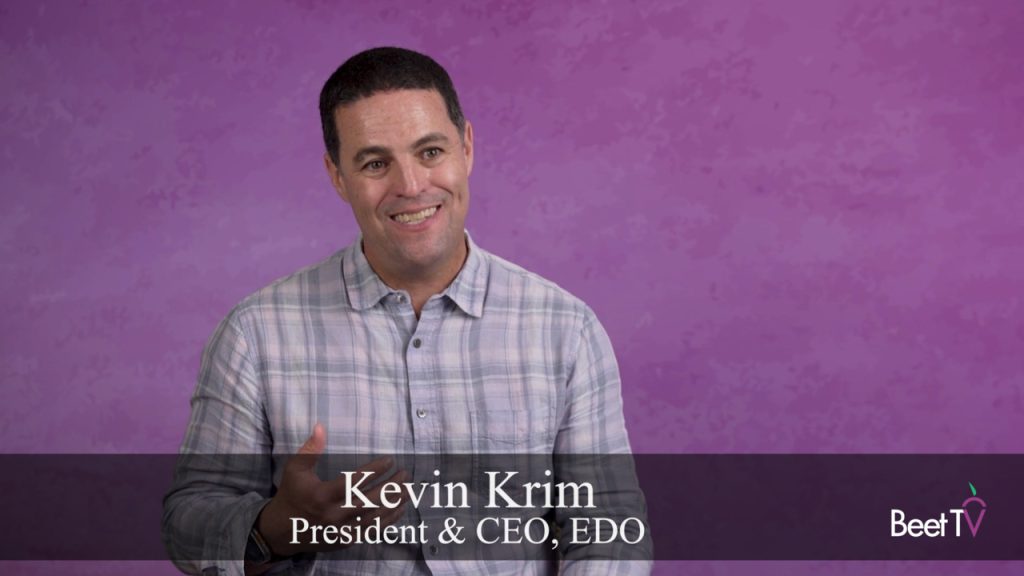
Everyone expected the usual buzzwords at the POSSIBLE conference: programmatic, attribution, maybe a few hot takes on cookieless futures. Instead, EDO CEO Kevin Krim dropped a bombshell that would make a psychology professor nod sagely: TV measurement needs to climb Maslow’s hierarchy. Yes, that Maslow. The one with the pyramid. It’s a stark departure from the spreadsheets and dashboard purgatory many ad execs inhabit daily.
Krim, speaking with Beet.TV, likened the current state of AI in advertising to a climb up that very pyramid. The idea is that AI can efficiently handle the foundational needs of measurement—the basic physiological and safety levels—freeing up human capital and budgets to pursue higher-order goals, what he terms “self-actualization.” It’s a refreshing, if slightly startling, way to frame the industry’s perpetual quest for better insights.
This framing instantly reframes the conversation. We’ve been stuck optimizing for basic recognition and recall for years. Krim’s argument, though, is that AI can drastically simplify and accelerate the process of meeting those fundamental needs, allowing us to finally address the more complex, nuanced aspects of advertising effectiveness.
Why TV Demands More Than Just ‘Awareness’
For too long, television has been relegated to the role of a sophisticated billboard—great for broad strokes, but notoriously difficult to track beyond vague notions of brand awareness. Krim is pushing back hard on this perception. He contends that TV advertising, especially when analyzed through the lens of modern AI-driven tools, demonstrably drives tangible, measurable consumer actions deeper into the funnel.
Think beyond just brand recall. We’re talking about immediate shifts in search behavior, direct website visits, app engagement, even subsequent interactions with AI chatbots, all directly attributable to a viewer seeing a TV ad. This is the crucial “how” and “why” that has eluded TV measurement for years, overshadowed by the seemingly effortless closed-loop attribution of search and social.
“What we’ve revealed by watching the customer journey and seeing the behaviors that are triggered by exposure to TV,” he said, is that viewers often move directly into action after exposure to ads.
This isn’t just anecdotal. EDO’s data, Krim suggests, increasingly supports television’s capacity to move consumers from passive viewing to active engagement. It’s a significant architectural shift in how we should perceive the medium’s role in the modern media mix.
The Enduring Power of Live Sports
And then there’s live sports. The price tags for sports rights continue to balloon, often defying traditional ROI logic. Krim offers a straightforward explanation: these events are the engine of the entire media ecosystem. The engagement rates for ads placed within live sports programming are, on a per-person basis, “significantly higher” than almost anything else.
This isn’t just about eyeballs; it’s about engaged eyeballs. Viewers of live sports aren’t just passively consuming content; they’re often invested not only in the game but also in the surrounding advertising. This intense focus creates a unique environment for advertisers, effectively replicating the high-stakes, high-reward model that makes events like the Super Bowl so lucrative for broadcasters.
AI: More Creative Variations, Fewer Dashboard Hostages
Amidst the current AI frenzy, where every vendor promises to revolutionize storytelling (often with hilariously flawed results), Krim offers a grounded perspective on creative AI. He believes the human element—taste, judgment—will remain central. However, he also highlights AI’s power to drastically reduce production costs and enable the generation of a far greater diversity of creative executions.
The old model, he argues, was born out of scarcity: the need for one or two “perfect” creatives for an entire campaign. With AI, marketers can explore myriad variations, letting performance data rather than gut instinct dictate which creative resonates most effectively with specific audiences and at different campaign moments. This suggests a move away from massive creative gambles towards a more data-driven, iterative approach to ad creation.
It’s a subtle but critical architectural shift: from crafting a few masterpieces to sculpting an entire gallery, then letting the audience vote with their attention.
ChatEDO: Escaping the Data Trap
Krim’s discussion of ChatEDO is particularly telling. EDO’s platform already boasts a massive dataset: 375 million ad airings and 2.6 million creatives collected over a decade. The challenge, however, has always been accessibility.
Before ChatEDO, extracting meaningful insights often meant an almost Sisyphean task for specialized power users navigating complex dashboards. The rest of the organization would be left in a state of perpetual anticipation, begging for another pivot table. ChatEDO promises to democratize this access, allowing marketers to pose questions—simple or complex—and receive answers in seconds, not hours.
This isn’t just about speed; it’s about fundamentally altering workflows. By freeing up teams from the arduous task of data wrangling, they can redirect their energy towards genuine optimization and achieving tangible business outcomes. It’s about moving up Maslow’s pyramid from the survival-level tasks of data extraction to the self-actualization level of strategic decision-making.
This is EDO’s bet: that by making sophisticated TV intelligence readily accessible, they can empower marketers to do more, understand more, and ultimately, achieve more—all thanks to a well-placed LLM and a dash of psychological theory.
🧬 Related Insights
- Read more: AI Agents 2026: 8 Shifts Moving Beyond ‘Usually’ to ‘Always’
- Read more: Bath & Body Works Gets a Brand Overhaul Artist
Frequently Asked Questions
What does EDO’s ChatEDO actually do? ChatEDO is an AI-powered interface that allows marketers to quickly access and analyze TV intelligence data by asking natural language questions, drastically reducing the time needed to get insights compared to traditional dashboards.
Will AI replace human creativity in advertising? EDO CEO Kevin Krim believes humans will remain central to creativity due to unique traits like taste and judgment. However, AI will lower production costs and enable the generation of many more creative variations, allowing data to guide optimization.
How does Maslow’s Hierarchy relate to TV measurement? Krim uses Maslow’s hierarchy to illustrate how AI can help the advertising industry move beyond basic measurement needs (like awareness metrics) to address higher-level objectives, leading to deeper insights and better business outcomes.