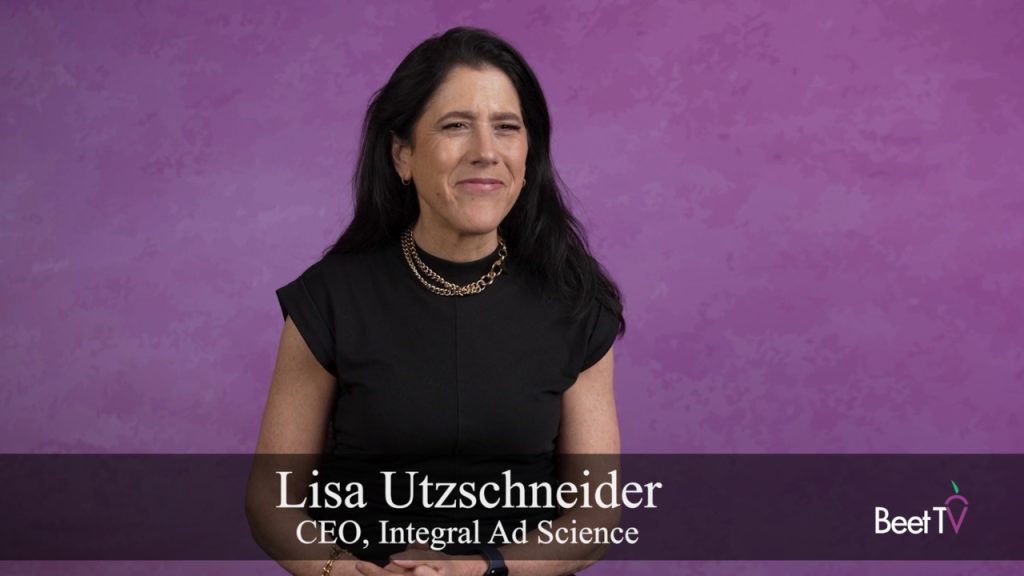
So, Integral Ad Science (IAS) is out there, flashing a number: 200X ROI. Sounds impressive, right? Their CEO, Lisa Utzschneider, trotted this figure out at some industry confab, linking their brand safety wares with Mastercard’s transactional data. The idea? That keeping your ads away from questionable content and instead placing them next to – well, paying customers – actually makes you more money. Who knew?
According to Utzschneider, they ran a beta with three big names – Progressive, Starbucks, and Verizon. The pitch is simple: IAS’s media quality checks, combined with Mastercard’s insights into what people actually buy, can prove that brand safety isn’t just some abstract concept peddled by verification vendors; it’s a direct driver of business outcomes. It’s the kind of claim that makes a seasoned reporter’s ears perk up – and their cynicism dial spin. Because, let’s be honest, in this industry, a 200x ROI is usually whispered about in hushed tones, often by someone trying to sell you something.
Is This Just Another Buzzword Bonanza?
The crux of the argument is that by layering media quality data on top of transactional data, they can demonstrate this colossal performance jump. Utzschneider states,
“We’re layering our media quality data on top of Mastercard’s transactional data. We recently ran a beta with three brands, Progressive, Starbucks, and Verizon. What it showed is with those three brands activating IAS’ solutions, we were able to demonstrate an ROI of over 200X performance by looking at the Mastercard transactional data.”
This isn’t just about keeping ads away from Nazis or dodgy content anymore; it’s about connecting that cleanliness directly to the cash register. For years, brand safety has been sold as a risk mitigation strategy, a firewall against reputational damage. Now, IAS wants you to believe it’s also a direct revenue-generating engine. It’s a bold pivot. The question, as always, is who’s actually making money here, and is the performance claim more than just a fancy chart?
Transparency in the Wild West of CTV
Beyond this headline-grabbing partnership, IAS is also pushing its ‘Total TV’ solution, aimed squarely at the bleeding edge of advertising: connected TV (CTV). Advertisers, Utzschneider explains, are hesitant to pour their traditional TV budgets into the streaming world because, frankly, it’s a bit of a black box compared to the dusty old linear channels. They want to know, just like they did with cable, which specific shows and channels their ads are appearing on.
“If you ask brands, why won’t you shift more linear TV dollars over into CTV? They often say it’s because I want the same transparency I get in linear TV. I want to know by channel, by show,” Utzschneider says. IAS claims Total TV provides this, integrating with the big players like Amazon Prime, Paramount, Disney, and NBCUniversal. It’s a necessary step, no doubt, if CTV is ever going to live up to its premium potential and shed its reputation as a digital Wild West.
Can an AI Agent Really Help Me See the Light?
Then there’s ‘IAS Agent,’ their customer-facing tool. This is supposed to give brands real-time analytics and let them see how these media quality solutions are supposedly driving that all-important ROI. It’s a move towards making the invisible, visible. The idea of putting “agentic functionality directly in customer hands for immediate business value” sounds good on paper, but the real test is whether it provides genuine insights or just a prettier dashboard with more numbers to ignore.
IAS is leaning heavily on its multimedia classification tech, powered by AI, for video, image, audio, and text. They boast “off the charts” accuracy and speed while maintaining costs. They’re even talking about integrating large language models (LLMs) to further refine their classification capabilities. It’s the AI arms race, applied to making sure your ads don’t end up next to something that makes your CMO spill their latte.
The Skeptic’s Take: Beyond the 200X Hype
Look, a 200X ROI claim is enough to make anyone pause. While the potential synergy between brand safety and transactional data is intriguing – it stands to reason that if you’re reaching the right audience in the right environment, and that audience is demonstrably making purchases, then there’s a clear connection – the devil is always in the details. How is this 200X calculated? Is it a direct uplift attributed solely to brand safety, or is it a composite of many factors including targeting, creative, and the inherent profitability of the brands involved? The original article offers little on the methodology behind this astronomical figure, which is a red flag for anyone who’s been around this industry long enough to see countless “revolutionary” metrics fall flat.
Historically, claims of massive, easily attributable ROI from media quality have been met with skepticism for good reason. It’s incredibly difficult to isolate the exact impact of brand safety alone from the myriad other variables that drive consumer behavior and sales. This partnership with Mastercard is certainly a compelling narrative, and if IAS can genuinely provide a clear line of sight from brand-safe placements to demonstrable purchasing decisions, it could shift the conversation significantly. But until we see the granular data and understand the precise methodology, treat that 200X figure with a healthy dose of that aforementioned cynicism. It’s a great soundbite, but the real story will be in the sustained, verifiable impact.
FAQs
What does Integral Ad Science do? Integral Ad Science (IAS) is a company that provides media quality and brand safety solutions for advertisers. They use technology to verify that ads are appearing in safe and suitable environments, and to measure ad delivery.
How does IAS work with Mastercard? IAS partners with Mastercard by layering its media quality data on top of Mastercard’s transactional data. This aims to demonstrate a measurable return on investment for brand safety and suitability efforts by linking ad placements to actual consumer purchases.
Is IAS Agent a new AI tool? IAS Agent is described as a customer-facing tool that provides real-time analytics and performance monitoring for IAS’s media quality solutions. While AI powers many of IAS’s classification technologies, the Agent tool focuses on delivering that performance data directly to clients.