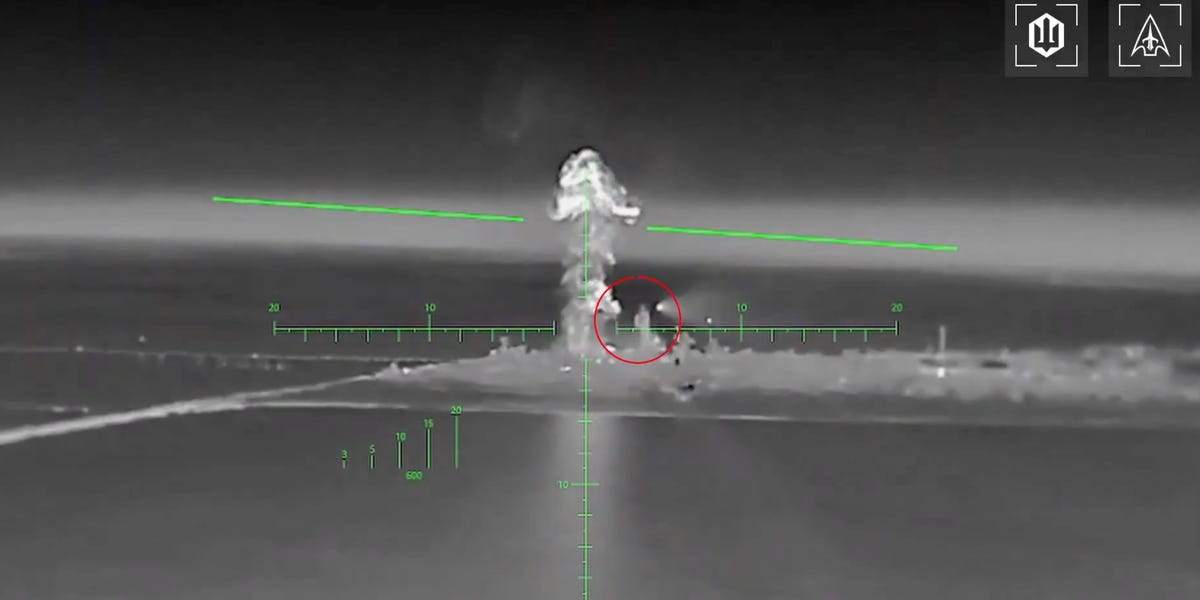
The dust settles, or rather, it hasn’t yet. A Ukrainian crew, tucked away, lobbed a shell, and bingo. Seven miles. A house. Direct hit.
This isn’t exactly a “tank-on-tank” showdown. It’s something else entirely. The 78th Separate Air Assault Brigade, armed with an Italian B1 Centauro, claims a direct hit on a building 11.1 kilometers out. That’s about 6.9 miles. Think about that distance for a second. It’s absurd.
They’re calling it a “closed position” shot. What does that even mean? It means they weren’t looking at the target. They fired blind, relying on coordinates and calculations. Like artillery, but with a tank cannon. This is how modern warfare plays out when drones fill the sky. You can’t just drive up and say hello anymore.
Is This New Strategy Actually Effective?
The gunner, known as “Khilya,” boasted about the 11,100-meter accuracy. The B1 Centauro, an 8x8 beast with a lighter punch than a main battle tank but packing a NATO-standard 105-mm cannon, proved its worth. It’s a tank destroyer, not a brawler. And apparently, it’s pretty good at playing sniper.
This isn’t the first time Ukrainian forces have stretched the definition of tank warfare. Back in 2022, a T-64BV crew supposedly nailed a Russian tank from 10,600 meters. The battlefield is changing. Drones, those buzzing nightmares, make direct engagements suicidal. So, crews are getting creative. They’re turning tanks into long-range artillery pieces.
“At the moment, to go tank-to-tank, you have to first get through a large number of FPV drones and all kinds of Molniya drones. That’s difficult. But from closed positions, this fires very accurately,” explained the commander, “Director.” He’s right. The sheer volume of aerial threats forces a tactical rethink. Why risk a direct slugfest when you can rain hell from afar?
The Centauro itself is an interesting beast. Mostly built in the 90s, these wheeled vehicles showed up in Ukraine in 2023. They’re not exactly cutting-edge, but they’re effective. This particular one was sporting some serious anti-drone netting. Cages on the chassis, a hood over the turret – it’s trying to survive the drone swarm. Smart.
But here’s the rub. The Centauro’s gun only angles up about 15 degrees. Most self-propelled howitzers can point theirs skyward 60-70 degrees. So, while it can shoot far, it’s not exactly lobbing shells over mountains. It’s a trade-off. Accuracy at range, limited elevation. It’s a compromise, like most things in war.
“The furthest shot I had was from a closed position. It was 11 kilometers. At 11,100 meters, I hit a building directly where they were sitting.”
This is where things get really interesting. Using a tank gun like artillery isn’t new. But doing it with such precision, at these distances, and with lighter vehicles… that’s the evolution. It’s a direct response to the drone saturation. If you can’t see them, or if seeing them means getting blown up, you find another way. And this is that other way.
Why Does This Matter for the War?
The real story here isn’t just the impressive range. It’s the strategic shift. Tanks are becoming less about direct assaults and more about indirect fire support. This blurs the lines between tank destroyers, artillery, and even some anti-air capabilities if you squint hard enough. The traditional roles are dissolving.
This also means targeting becomes a different ballgame. If a shell can land 7 miles away with pinpoint accuracy, the enemy’s cover isn’t as safe. Hiding in a building 7 miles behind the front lines? Not anymore. This extends the battlefield significantly. It forces an opponent to think about threats coming from much further afield.
So, while the original report might focus on a specific Italian tank’s impressive feat, the real takeaway is the adaptation. Ukrainian forces are proving incredibly resourceful, bending existing hardware to new, brutal realities. It’s a proof to human ingenuity under duress, and a chilling reminder of how quickly military tactics can change when faced with new threats.
The next time you think of a tank, remember the B1 Centauro. It’s not just rolling forward. It’s aiming over the horizon. And hitting what it aims for.
🧬 Related Insights
- Read more: Target’s Tiny Upgrades: Can Carts & Baths Win Big?
- Read more: StackAdapt’s AI Overhaul: Beyond Reactivity?
Frequently Asked Questions
What is a B1 Centauro? A B1 Centauro is an Italian 8x8 wheeled tank destroyer equipped with a 105-mm cannon, designed for high mobility and long-range engagements, often used in a support role rather than direct combat.
How is this different from artillery? While both fire shells at targets, artillery pieces typically have higher elevation angles allowing for indirect fire over obstacles. This Centauro shot was indirect but likely had limitations in achievable elevation compared to dedicated howitzers.
Will this change how tanks are used in the future? This incident highlights a growing trend of using armored vehicles for long-range indirect fire, especially in drone-heavy environments. Future tank designs might incorporate enhanced indirect fire capabilities or integrate more closely with artillery systems.