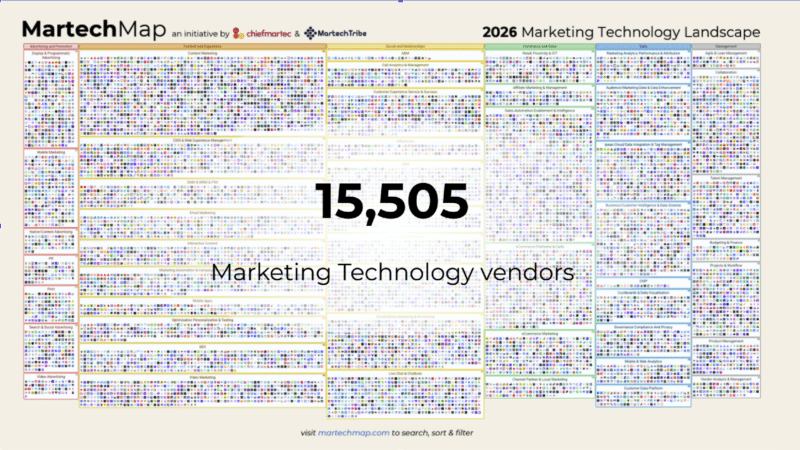
Have you ever stopped to think that the tools your marketing team actually uses are the ones you’ve never heard of?
It’s a question that hits like a lightning strike, and it’s precisely the one AdTech Beat readers should be asking right now. We’re talking about a seismic shift, a fundamental platform change that’s happening beneath the polished chrome of your sanctioned enterprise solutions. Your marketing team isn’t just not using the martech stack you so carefully — or perhaps carelessly — purchased. They’ve already built their own, a digital rebellion happening in plain sight, powered by the very technologies we’re all scrambling to understand. This isn’t adoption friction; it’s a full-blown mutiny.
The illusion of control is powerful. You’re deep in the trenches, defending that two-year-old DXP purchase, or wrestling with a stack inherited from a predecessor. Meanwhile, your direct reports? They’ve figured it out. They know what sings and what sinks. They’ve woven a complex web of workarounds, stitching together solutions like a digital quilt, all while your official platforms gather digital dust.
This isn’t about malicious intent. It’s about efficacy. It’s about the relentless pursuit of getting the job done. And when the tools you’ve mandated simply don’t cut it, what are people supposed to do? Watch the progress crawl to a halt?
The Ghost in the Machine: Dark Martech’s Dominion
This isn’t a walkout. No HR complaints are filed. Your sanctioned tools still appear on spreadsheets, people dutifully attend the mandated training sessions, nodding along to slick demos. Then? Back at their desks, they revert to what works. Scott Brinker, a sage in the martech wilderness, flagged this years ago as ‘dark martech’— the unsanctioned, untracked, and often unknown tools humming away within organizations. The label never quite stuck, but the behavior? It’s a runaway train.
Think about the sheer scale. WalkMe’s 2026 State of Digital Adoption report paints a staggering picture: executives estimate 35 apps are used. The reality? A whopping 661. Every function, every department, every team is a sovereign nation of software, operating beyond the gaze of leadership. And marketing? Identical. The CMO is the one left holding the bag, responsible for a gap they didn’t even know existed.
The 2024 MarTech Composability Survey by chiefmartec and MartechTribe adds flesh to these bones. A jaw-dropping 82.7% of marketers ditch central platforms for specialist apps. Why? Better functionality, better user experience. Your team ran the evaluation, delivered their verdict, and moved on—all in roughly 60 days. You found out much, much later, if at all.
That’s how organized dissent blossoms. No manifestos needed. The stack simply splits. The official tools become relics. The real workhorses operate in the shadows.
And the workaround economy? It’s the glue holding it all together. That one person who knows the manual fix, the spreadsheet that bridges data gaps, the Slack thread that replaced that expensive automation platform? Pull them, and everything grinds to a halt. They are living proof the official tool was always a dud.
The CMO’s Tightrope: A Study in Exposed Vulnerability
Only 30% of Go-To-Market teams feel their stack fosters alignment. Over half point to disconnected tools and workflows as the primary saboteur of execution. Marketers, more than any other function, feel this acutely because they depend on shared systems and long feedback loops. When those systems fracture, they’re navigating blind.
CMOs are uniquely exposed to this phenomenon. Their tenure is often shorter – Spencer Stuart’s 2026 CMO Tenure study shows an average of 4.1 years in the S&P 500, compared to 5.0 for the C-suite. That’s a tiny window to build the kind of trust that makes your tech choices gospel. Your MOps lead? They’ve likely been around longer. They’ve seen platform migrations come and go, they know the true cost. You’re the new kid.
Then there’s the technical chasm. Many CMOs remain detached from the daily grind of martech decisions. When you delegate stack strategy entirely to MOps, accountability lands squarely on you, but visibility? That evaporates. Your team fills the void, and once they’re in the driver’s seat, control isn’t easily relinquished.
The LXA State of Martech survey echoes this, with 49% of CMOs citing internal resistance as a major challenge and 60% admitting they lack the time for proper tool evaluation. Rushed decisions lead to poor fits, workarounds multiply, and the credibility gap widens before anyone realizes the tool was a lemon. All the while, CFOs are tightening the screws on martech spend, with AI ROI provability dropping from 49% to 41% in just one year. When marketing can’t prove value, finance makes its own grim calculations. Pressure from above, dissent from below – a toxic cocktail.
The Echoes of Bad Bets: Inherited Stacks and Failed Gambles
Two paths inevitably lead to this quiet rebellion.
First, the inherited stack. You walk in to find a marketing automation platform on a three-year contract signed by your predecessor, an analytics tool nobody has touched in six months, and a data integration held together by one person whose LinkedIn is already updated. Your team made its judgment calls before you even arrived. They know what’s functional and what’s duct-taped together. They’re just waiting to see if you’ll double down on the status quo or recognize the truth.
The second scenario? It’s the bad bet. You, or someone on your team, bought into a shiny new platform that promised the moon, only to discover it delivered little more than disappointment and a steep learning curve. The team, left to clean up the mess, cobbles together a solution that actually works. This isn’t just about choosing the wrong tools; it’s about a fundamental disconnect between the promise of enterprise solutions and the messy, dynamic reality of modern marketing.
The AI Tsunami: Platform Shift in Action
Here’s where the futurist in me gets excited. This isn’t just a martech problem; it’s a symptom of a much larger platform shift, an AI-driven revolution that’s democratizing power. Think of AI not just as a tool, but as a new operating system for business. Just as the internet rendered monolithic, centralized systems less effective, AI empowers individuals and small teams to build hyper-efficient, bespoke solutions. These aren’t just ‘specialist apps’; they are AI-native workflows that are orders of magnitude more effective and intuitive than the clunky, generalized enterprise platforms of yesteryear.
Your team isn’t choosing specialist apps; they’re choosing AI-powered agents that understand their specific needs, adapt to their workflows, and deliver results with a speed and agility that legacy systems can only dream of. This is the dawn of composable intelligence, where individual AI modules can be snapped together to create bespoke solutions for any marketing challenge. The enterprise platforms you bought? They’re the AOL of the AI era – once dominant, now quaintly obsolete in the face of a genuinely new paradigm.
The data proves it. Marketers are voting with their time and their output. They’re not being difficult; they’re being smart. They’re recognizing that the true engine of innovation and efficiency isn’t a centralized, top-down platform but a decentralized, intelligent network of specialized AI tools. The companies that embrace this reality, that empower their teams to build and use these AI-native workflows, will be the ones that lead the charge into the next decade. The rest will be left defending dinosaur stacks while their competitors zoom ahead on the wings of artificial intelligence.
The Future is Now: What Does This Mean for Your Stack?
So, what’s a CMO or a tech leader to do?
First, stop defending the indefensible. Your current stack is likely a patchwork of compromises and unmet expectations. Embrace the idea of composable martech, but not in the way the vendors are selling it – think composable intelligence, powered by AI. Instead of buying monolithic platforms, invest in an ecosystem that allows teams to find, integrate, and optimize the best AI-powered tools for their specific tasks.
Second, listen. Really listen. Conduct ethnographic research within your teams. Understand the workarounds, the spreadsheets, the Slack threads. These aren’t signs of rebellion; they’re signals of unmet needs and brilliant improvisation. Ask your teams: ‘What tools would you build if you had the power?’ The answers might surprise you.
Third, reconsider your vendor relationships. Are they enabling composability, or are they locking you into their walled gardens? Look for partners who offer APIs and integrations that allow for smoothly connection with a diverse range of AI tools. The future isn’t about owning the entire martech farm; it’s about curating the best AI produce from around the world.
This is a fundamental platform shift. AI isn’t just another feature to bolt onto existing software. It’s a new foundation. And your marketing team, whether you realize it or not, is already building on it. The question is, are you going to join them on the new ground, or be buried under the rubble of the old?
82.7% of marketers routinely choose specialist apps over what their central platform provides.
This isn’t a trend; it’s a declaration of independence. Your team has already voted, and the results are in. The future of marketing technology isn’t in the enterprise platforms you’re defending; it’s in the intelligent, adaptable, AI-powered tools your team is already using—or building—to get the job done.