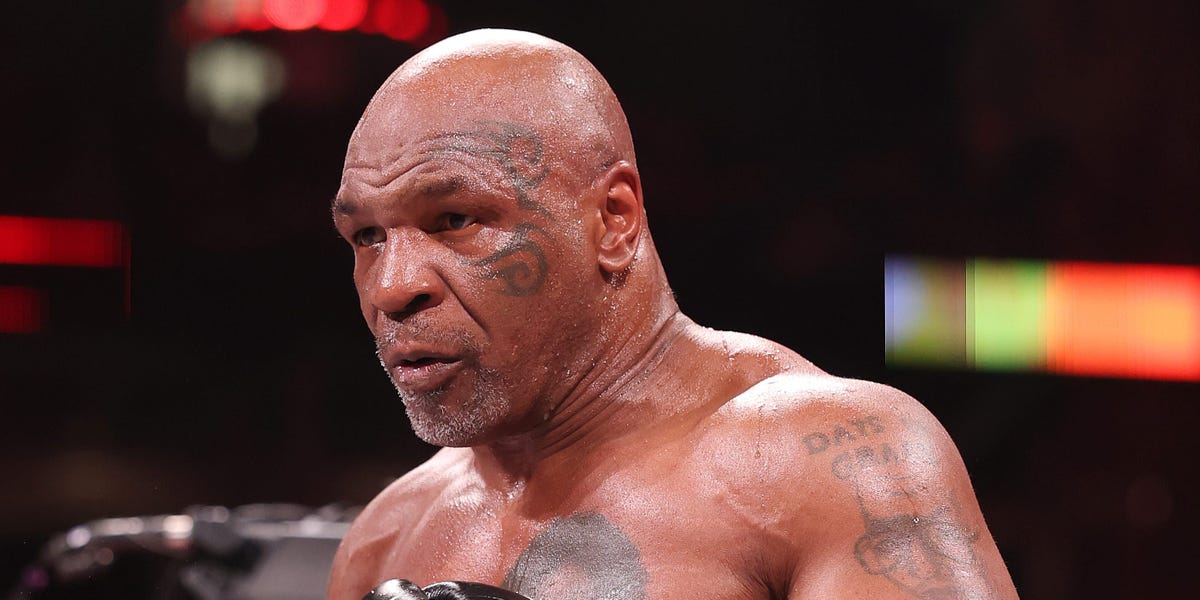
The quiet, internal voice. It’s the unheralded architect of our actions, the silent partner in our triumphs and failures. For Mike Tyson, this internal monologue wasn’t just a background hum; it was a meticulously crafted tool, honed by a mentor who understood the raw power of self-belief.
This isn’t about a training regimen or a special diet. It’s about something far more fundamental: the words we choose to whisper, or shout, to ourselves when no one else is listening. Tyson, now 59, attributes his meteoric rise in the boxing world, culminating in his heavyweight championship at just 20 years old, to a single piece of advice imparted by his mentor, Cus D’Amato, when he was a mere 12-year-old.
“Always say beautiful things about myself and never say anything negative about myself because my subconscious don’t know if I’m playing or not,” Tyson recounted on the ‘This Past Weekend’ podcast. It’s a profound observation on the nature of our inner programming.
D’Amato’s wisdom wasn’t just about motivational posters; it was a deep dive into the mechanics of the human psyche. He understood that the mind, particularly a young, impressionable one, doesn’t always differentiate between genuine self-criticism and ironic jesting. What you feed it, it believes. And for a burgeoning champion, the input needed to be nothing short of extraordinary.
Think about that. A kid, likely grappling with insecurities and the harsh realities of his environment, being instructed to actively construct a narrative of strength and inherent worth. This wasn’t about delusion; it was about directed mental energy. It was about building an unassailable internal fortress that could withstand the external onslaught of opponents, public scrutiny, and the sheer pressure of the sport.
The Subconscious Code: How D’Amato Rewired Tyson’s Brain
Tyson emphasizes that the timing was everything. Learning this lesson at 12 allowed him the critical years to internalize it, to make it second nature, so that by the time he stepped into the championship spotlight at 20, it was an ingrained part of his being. Imagine the alternative: a talented individual struggling with self-doubt in their late teens, desperately trying to implant a positive mindset just as the stakes skyrocket. D’Amato’s foresight was, in this context, a strategic masterstroke.
This principle of positive self-talk isn’t unique to the boxing ring, of course. We’ve seen variations of it surface in other high-pressure fields. Kylie Kelce, for instance, speaks of modeling self-love for her children, understanding that early exposure to positive self-narration can be foundational for confidence. Similarly, Barbara Corcoran openly discusses how she consciously reframed her inner dialogue, replacing self-defeating narratives with affirmations of her capabilities.
But Tyson’s story, rooted in the raw, visceral world of professional boxing and guided by the paternal figure of D’Amato, offers a potent distillation of the concept. D’Amato wasn’t just a boxing coach; he became Tyson’s legal guardian after his mother’s passing, providing a stability and structure that was arguably as crucial as any punch D’Amato taught him to throw. This holistic approach—nurturing the mind and spirit alongside the body—is what truly sets D’Amato’s influence apart.
The Ghost in the Machine: An Unforeseen Impact
What strikes me most is the profound simplicity of D’Amato’s method, juxtaposed with the immense complexity of Tyson’s rise. It’s an architectural shift in how one approaches potential. Instead of focusing solely on external techniques or physical conditioning, D’Amato built the foundation from the inside out. He recognized that the most formidable opponent Tyson would ever face wasn’t in the opposite corner, but within his own mind. And he armed him with the ultimate weapon: an unshakeable belief in his own greatness.
It’s a lesson that transcends sports, a blueprint for anyone looking to harness their own potential. The words we use with ourselves are the most powerful words we will ever utter. They are the code we write for our own operating system, and they determine, quite literally, what we are capable of achieving.
“Always say beautiful things about myself and never say anything negative about myself because my subconscious don’t know if I’m playing or not.”
This isn’t just a quote from a boxing legend; it’s a critical insight into the human condition. It’s a reminder that the arena where the real battles are won or lost is the one between our own ears.
🧬 Related Insights
- Read more: What is Identity Resolution?
- Read more: Shrinking Audiences for Leads? You’re Dooming Your ROI
Frequently Asked Questions
What did Cus D’Amato teach Mike Tyson? Cus D’Amato taught Mike Tyson the importance of positive self-talk, instructing him to always say beautiful things about himself and never anything negative, as the subconscious mind doesn’t distinguish between genuine criticism and jokes.
When did Mike Tyson become world heavyweight champion? Mike Tyson became the youngest world heavyweight boxing champion on November 22, 1986, at 20 years, 145 days old.