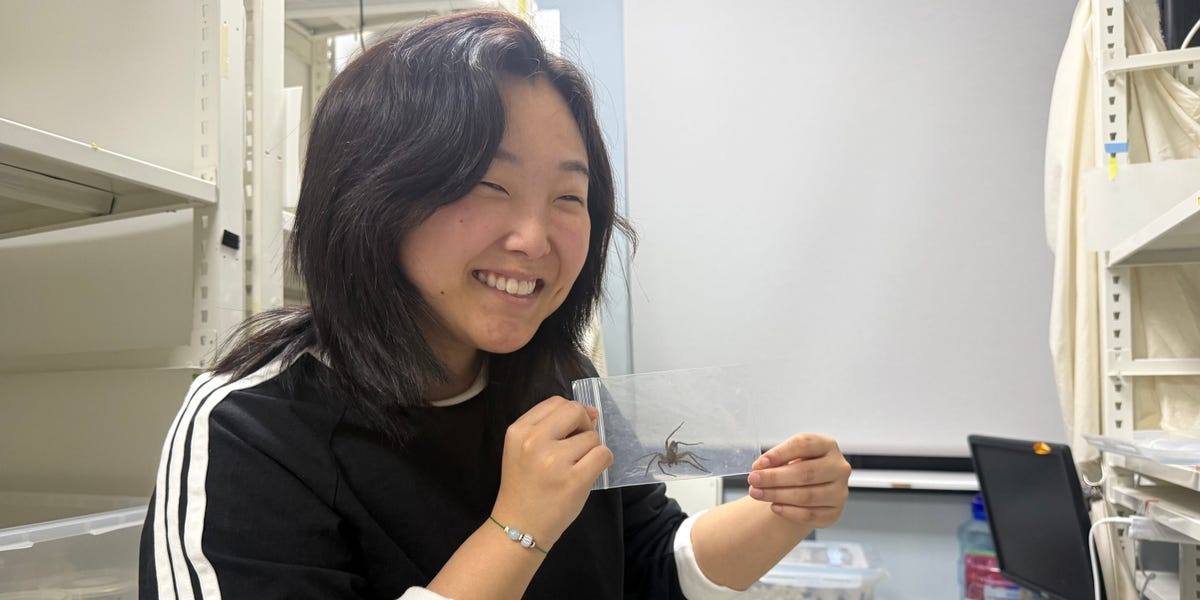
So, you think you know who you are? Most folks, myself included, tend to operate under the assumption that our identities are pretty locked in by the time we hit adulthood. We’ve got our upbringing, our experiences, our cultural touchstones. But what happens when a significant piece of that puzzle is, well, a blank slate? Jillian Kurovski, a 27-year-old Ph.D. student, was adopted from South Korea as a baby and raised in the heartland of America, the Midwest. For years, she navigated life with a dual awareness: she knew she was Korean, but she didn’t feel it. The story of her year-long research stint in Seoul, however, is a fascinating case study in how a physical return can trigger an internal reconciliation.
It’s funny how life throws these curveballs. Kurovski was knee-deep in spider research – yes, spiders – in Guam, of all places, when an email landed that would change her trajectory. Her birth mother wanted to meet. Imagine that. After eight months in Daegu, South Korea, she’d been whisked away to a loving, very Midwest family in Iowa. Her adoption was an open book, no secrets. But growing up in a predominantly white community meant that while she knew she was Korean, the language to articulate that part of herself was missing.
There’s this gnawing feeling that’s hard to shake. Kurovski recalls a junior high assignment: bring an artifact from your family’s heritage. She agonized. Irish? Czech? Korean? The last one was a non-starter. She knew nothing. So, she cobbled together a story about an Irish friendship ring, a presentation that felt like a fraud even as she delivered it. That gnawing feeling? That’s the space where a significant part of one’s identity is supposed to be, and it’s empty.
The Spur-of-the-Moment Search
Sometimes, it takes a jolt. In 2018, Kurovski dipped her toe into birth search waters via her adoption agency. It was almost an afterthought, sandwiched between undergraduate spider research and a planned trip to Guam. Her lab manager gave her a choice for travel: Hawaii or South Korea. The latter, naturally. Her three-day layover in her birth country was intentionally short, yet undeniably impactful. Spending that week with her birth family – a whirlwind of learning etiquette, practicing bows, and trying to be the ‘perfect Korean daughter’ – was, by all accounts, special. Leaving was brutal.
But the seed was planted. How to return? How to reclaim that missing narrative? The answer came in the form of the Fulbright Presidential STEM scholarship. Her Ph.D. research on spider reproduction, a seemingly niche pursuit, became her passport back to Seoul for a full year, starting in July 2025. This time, her birth family was at the airport to meet her. It wasn’t just a layover; it was an immersion.
Bridging the Divide, One Text at a Time
Over the past year, the relationship has, by Kurovski’s account, started to feel… normal-ish. They text about everyday things – when she’s visiting, what she’s up to. Her dad sends random YouTube videos. It’s the small gestures that build the bridge. The biggest hurdle, though? Language. Her family speaks little English, and her Korean is rudimentary. Conversations are a mosaic of broken phrases and gestures. She feels the gap acutely with her mother, yearning for full stories, for deeper connection.
It’s a sentiment many adoptees can likely relate to: the desire for the unadulterated narrative, the unedited life story, shared in the language of origin. The ability to truly hear a parent’s life, and to share your own in return, is fundamental.
“I wish I could hear her tell a full story. I want to know about her life, and I want her to know mine.”
Spiders, Identity, and the In-Between
Here’s where it gets interesting, and frankly, a little poetic. Kurovski’s research – spiders – has become an unexpected metaphor for her own identity. Both are often misunderstood. Both exist in a liminal space: spiders as predator and prey, adoptees and multicultural individuals often feeling caught between worlds, not entirely one thing or the other, but existing in that complex middle ground. Her work on reproduction and bringing life into the world has also apparently made her appreciate her mothers – both birth and adoptive – more deeply. Parenthood, it seems, is a universal language.
For years, she wrestled with the external narrative: “You’re not Korean.” “You’re not American.” Now, living in Korea, experiencing the culture, having her birth family actively pass it down, she’s finding her footing. It’s not about choosing one over the other. It’s about integration. Her adoptive family remains her fiercest champions – apparently, her adoptive mom was more thrilled about the birth family reunion than Kurovski herself.
She’s come to love being Korean. She also loves being American. It’s not an either/or situation; it’s a vibrant, sometimes messy, but ultimately authentic synthesis. The Midwest raised her, but Seoul is helping her understand her Korean half, not as an abstract concept, but as a lived reality. This isn’t just about finding her birth family; it’s about finding the missing pieces of herself, stitched together by research grants and a whole lot of courage.
Has the corporate world finally cracked the code on long-term customer loyalty, or is this just another shiny object?
We’ve seen this song and dance before. Companies hawk new platforms, new methodologies, new AI-driven everything, all promising to unlock the secret to keeping customers hooked. And for a while, it works. The novelty alone generates buzz. But the real test? Sustained engagement. The kind that translates into revenue year after year, not just a temporary spike. Kurovski’s personal journey highlights a profound human need for connection and belonging, something that can’t be simulated or bought off the shelf. While her story isn’t directly about AdTech, it’s a potent reminder that at the heart of every transaction, every engagement, is a human being searching for meaning and connection. Anyone selling a solution that ignores that fundamental truth is likely selling snake oil.
Is a year abroad enough to redefine identity?
For Kurovski, it certainly seems to be a significant catalyst. While a year isn’t a magic bullet, it provided the immersive experience and direct connection she needed to reconcile her dual heritage. It’s less about erasing her Midwest upbringing and more about adding and integrating her Korean identity in a meaningful way.
What does this mean for adoptees and multicultural individuals?
Kurovski’s experience suggests that actively engaging with one’s heritage, especially through direct experience and connection with birth family, can be incredibly powerful for identity formation. It validates the complexity of existing between cultures and offers a path toward embracing that space rather than feeling caught in it. It’s a reminder that identity isn’t always singular or easily defined, and that’s perfectly okay—even beautiful.