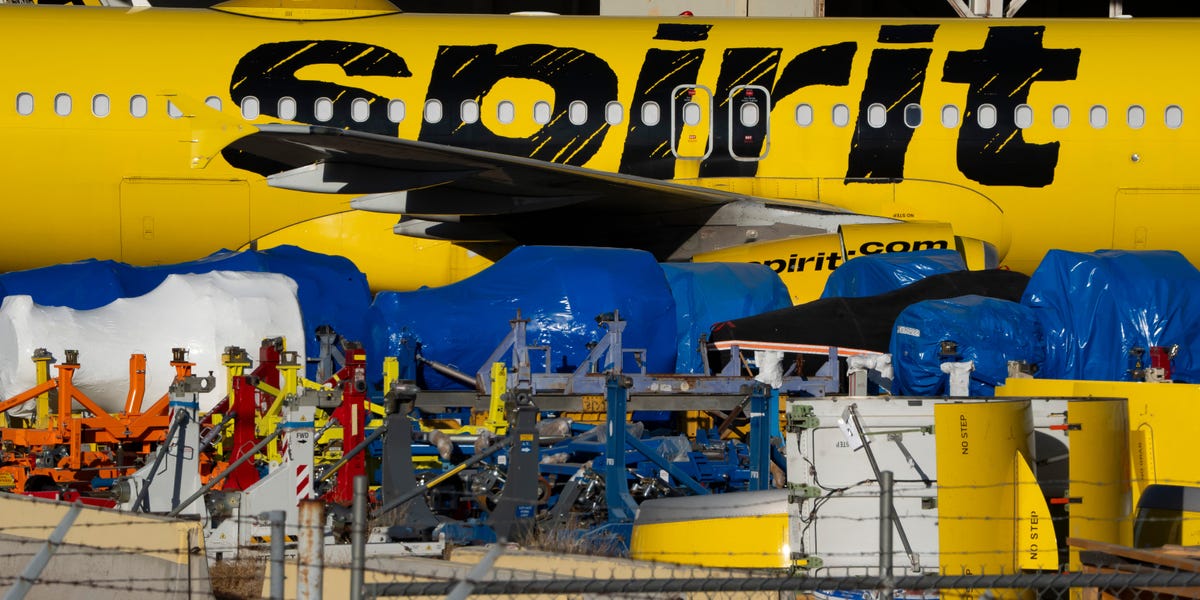
So, a brand-new airplane, fresh off the assembly line and worth over $100 million, is being fed into an excavator. Not because it’s a lemon, but because its heart — its engines — are temporarily unusable. That’s the unbelievable story unfolding in the aviation world right now, and it’s a powerful metaphor for how a single, critical component can bring an entire, complex system to its knees.
This isn’t just about Spirit Airlines’ unfortunate financial tumble; it’s about the Pratt & Whitney geared turbofan (GTF) engines. A manufacturing defect, discovered last year, has forced the grounding of hundreds of A320neo-family aircraft worldwide. And when you have that many planes out of commission, with limited repair capacity and a choked supply chain, basic economics goes haywire. Suddenly, a working engine, or even just the parts from one, becomes more precious than the entire airframe it powers.
It’s like finding a cure for a rare disease, but only having enough of the antidote for a handful of patients. The demand spikes, the scarcity bites, and the value proposition flips entirely.
Why Scrapping a Jet Makes Sense Now
Think about it: leasing a pair of these coveted GTF engines can run an airline upwards of $400,000 per month, or nearly $4.8 million annually. That’s a staggering figure, approaching or even exceeding the cost of leasing an entire, flying airplane. When the fix for these engines can take an estimated 300 days (yes, nearly a year!) for airlines like JetBlue, waiting becomes an astronomical expense. It’s far more cost-effective, in this bizarre market, to strip down a perfectly good jet for its valuable spare parts — avionics, landing gear, and especially those prized engines — and use them to keep other, operational aircraft in the air. This single A320neo can effectively become a lifeline for multiple others.
“This significant transaction” acquired four sets of in-demand spare parts and components.
This whole situation is a stark reminder that our most advanced systems are only as strong as their weakest link. And right now, that link is squarely on the engine. We’re seeing a fundamental platform shift playing out in real-time, driven not by a new user interface or a killer app, but by a critical, physical component failing on a massive scale.
It’s an almost absurd irony: jets that are barely four years old, designed for peak efficiency and modernity, are meeting their end not in a fiery crash, but under the methodical deconstruction of salvage crews. They’re being cannibalized to sustain the ongoing operations of their brethren. It’s less a ‘death’ and more a ‘repurposing on an industrial scale.’
Is This the Future of Aircraft Maintenance?
While Pratt & Whitney assures us they’re ramping up repair capacity and that the grounding numbers are decreasing, the backlog is immense. The collapse of Spirit Airlines, with its large fleet of GTF-powered jets, has only added to the pool of available aircraft for teardown. These aren’t just a few stray planes; we’re talking about dozens potentially entering the ‘parts pipeline.’ Some might get a new lease on life with engines swapped over, others will be fully dismantled. It’s a chaotic, dynamic market, and the ultimate fate of many of these planes remains, as one ferry pilot put it, ‘nobody knows.’
This isn’t the first time supply chain issues have had outsized effects, but the scale here is breathtaking. It’s a harsh, tangible demonstration of how interconnected our world is, and how a single point of failure, especially in a high-stakes industry like aviation, can ripple outwards with devastating economic consequences. The vision of a brand-new jet being torn apart for its engines is a jarring image, a stark warning, and a bizarre proof to the complex, sometimes irrational, economics of the modern industrial age.
🧬 Related Insights
- Read more: Snap’s Unified Attribution: Ending Self-Grading?
- Read more: AI Agents & Ad Tech: 150 Developers Tackle Commerce Infrastructure
Frequently Asked Questions
What does Pratt & Whitney’s GTF engine issue mean for airlines? It means significant disruptions, costly repairs, and in some cases, the premature dismantling of aircraft for parts because replacement engines are scarce and repairs take months.
Are all Airbus A320neos affected by the engine problem? No, only specific models within the A320neo family that are equipped with the affected Pratt & Whitney geared turbofan engines. Other A320neo variants with different engine types are not impacted.
Can I buy parts from these scrapped jets? Parts from aircraft teardowns are typically sold through specialized aviation aftermarket suppliers like AerSale and EirTrade Aviation, who then redistribute them to airlines and maintenance providers.