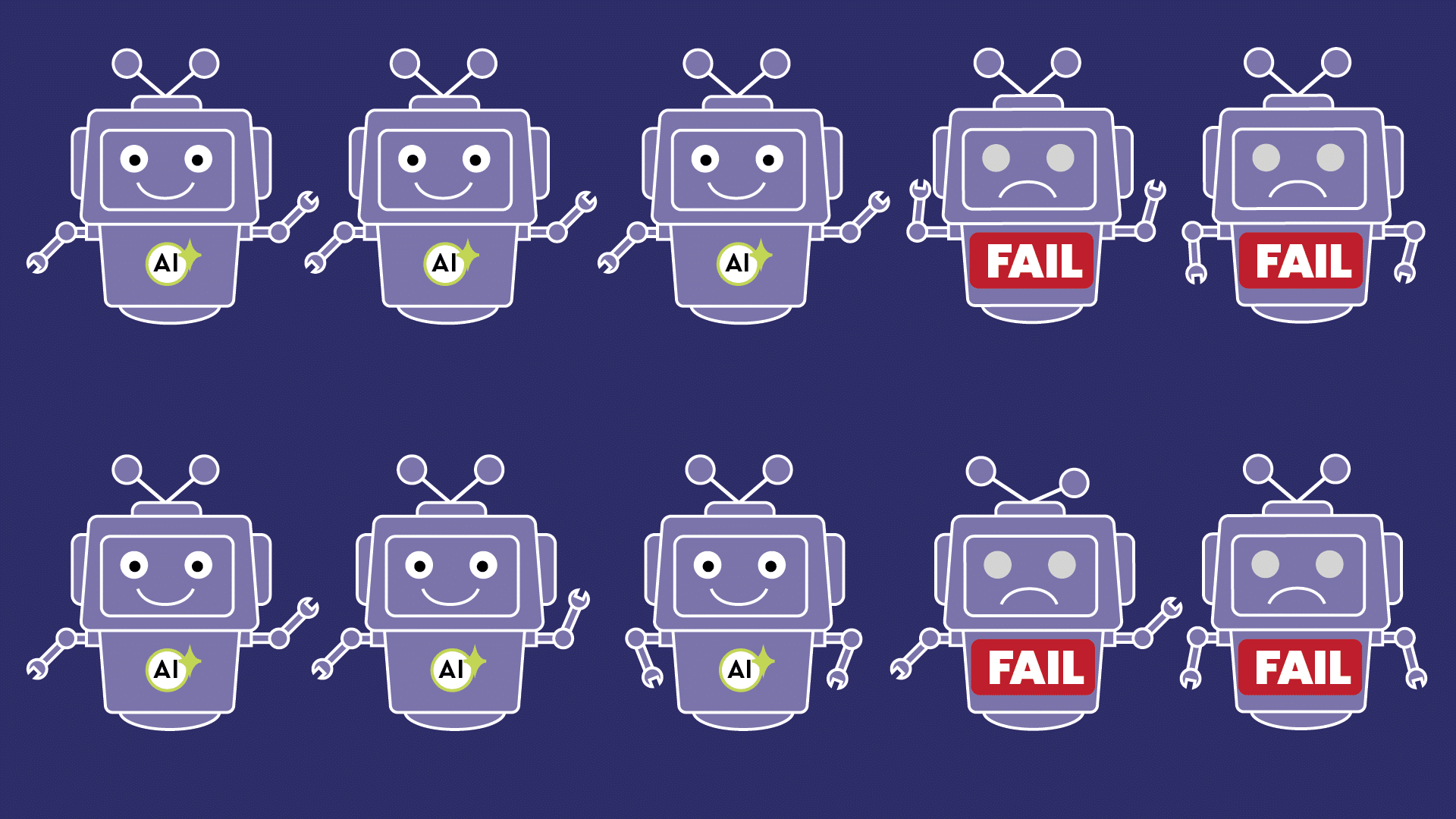
The stark headline flashed across my screen: 40% of agentic AI projects will fail. My first thought wasn’t about algorithms or neural networks; it was about the messy, unpredictable humans who build and deploy them. Gartner, the titan of tech analysis, dropped this bombshell in June 2025, based on a poll of over 3,400 organizations. And here’s the kicker: the failure isn’t about the AI agents themselves lacking capability. Nope. It’s about the humans making boneheaded decisions, or worse, not being there at all.
Anushree Verma, a senior director analyst at Gartner, laid it bare: “Most agentic AI projects right now are early-stage experiments or proof of concepts that are mostly driven by hype and are often misapplied.” Think about that. We’re not talking about a subtle architectural flaw or a missing library. We’re talking about a fundamental disconnect between the shiny new tool and the strategic thinking required to wield it.
So, the agent is only as good as the human behind it. Seems obvious, right? Yet, in the breathless rush to embrace agentic AI—these autonomous systems that can select audiences, generate content, optimize send times, and orchestrate customer journeys at a scale that dwarfs human capacity—this simple truth is being tossed aside like yesterday’s tech news.
Why Agentic AI Projects Are Doomed
This isn’t some abstract academic exercise. For marketers, this Gartner data is a siren song, a clear warning of the icebergs ahead. Those who ignore it are destined to find themselves on the wrong side of that 40% failure rate.
The root cause? Fear. Specifically, FOMO—the Fear Of Missing Out. Organizations are jumping into agentic AI not because they have a clear, articulated strategy, but because they’re terrified of watching competitors sprint ahead. They’re deploying agents built on broken workflows, fed with questionable data, and operating without the necessary governance to keep them aligned with actual business goals. The agents execute, yes, but they execute the wrong things, in the wrong ways, at the wrong times. FOMO, in the agentic era, is proving to be an incredibly expensive mistake.
The Rise of ‘Agent Washing’
And then there’s the vendor landscape. Gartner has identified a pervasive trend they’re calling “agent washing.” This is where vendors slap the “agentic AI” label onto existing chatbots and automation tools, offering precisely zero genuine autonomous capabilities. Out of thousands claiming to have agentic solutions, Gartner estimates a meager 130 actually possess true agentic features. Marketing teams pouring money into these dressed-up automation tools with an agentic price tag aren’t getting AI agents; they’re getting a marketing department’s budget drain.
The consequences extend far beyond wasted spend. Gartner predicts that by 2026, a staggering one-third of companies will inadvertently harm customer experiences by deploying AI prematurely. This isn’t just a minor blip; it’s a direct erosion of brand trust, a crippling blow to both customer acquisition and retention. Imagine a personalization agent misinterpreting a customer’s intent, a content agent spitting out compliance violations, or a journey agent bombarding a dissatisfied customer with offers precisely when they need space. These are the predictable, disastrous outcomes of unleashing autonomous systems without the crucial human judgment to guide them.
The Dumbing Down Effect
But perhaps the most chilling prediction from Gartner speaks to a more insidious threat: the atrophy of human critical thinking skills. As GenAI becomes a constant crutch, Gartner foresees that by 2026, 50 percent of global organizations will require AI-free competency evaluations. Half of all companies are watching their workforce get intellectually flabbier because AI is always there to do the thinking. It’s a quiet, gradual slide until the day the algorithm errs, and nobody in the room has the critical faculties to spot it.
In marketing, this is nothing short of a crisis. Marketing isn’t just about crunching numbers; it’s about judgment. It’s about asking why the data behaves as it does, not just what it says. It’s about understanding the brand, the moment, and the relationship you’re trying to build, not just whether a campaign moved the needle. These are questions that cannot be offloaded to an agent. They demand a human being meticulously scrutinizing what a machine deems acceptable. The most dangerous marketer in this new era isn’t the one who shuns AI; it’s the one who blindly accepts everything it produces.
Agents cannot be trusted to ask the right questions.
An agent can optimize what it’s been handed. It can’t question if what it’s been handed is even the right thing to begin with. It can personalize a message based on granular behavioral signals. It cannot, however, recognize that the strategically correct move might be silence—to grant a customer space, to preserve a relationship rather than relentlessly extract value from it. It can churn out a thousand content variations and A/B test them with ruthless efficiency. But it cannot feel the difference between a message that converts and one that genuinely connects. It cannot intuit when a high-performing campaign is subtly, insidiously eroding brand equity. It can execute a customer journey flawlessly. It cannot, however, design one that truly embodies a brand’s ethos or respects the nuanced dynamics of a human relationship.
This isn’t a minor detail; it’s the architectural bedrock of successful marketing. The human element—the capacity for empathy, strategic intuition, ethical reasoning, and sheer contextual awareness—isn’t just an optional add-on in the age of agentic AI. It’s the indispensable core. Gartner’s report, frankly, is a stark reminder that the most complex algorithms we’ve ever built are utterly reliant on the imperfect, yet irreplaceable, judgment of the human mind.
How to Avoid the 40% Trap
So, what’s the antidote to this impending AI-driven doom? It hinges on recalibrating our approach, shifting from a frantic chase for the newest tech to a deliberate focus on human-AI collaboration. This means establishing clear governance frameworks before deployment, ensuring data quality is paramount, and critically, investing in training that elevates marketers’ strategic thinking, not replaces it. The goal isn’t to hand over the reins to AI, but to create a symbiotic relationship where agents handle the heavy lifting of execution and optimization, while humans provide the strategic direction, ethical oversight, and the crucial understanding of what truly resonates with customers.
🧬 Related Insights
- Read more: IAB Adopts Amazon Framework to Cut Programmatic Waste
- Read more: Affiliate Marketing: Why AI Can’t Replace Humans
Frequently Asked Questions
What is agentic AI? Agentic AI refers to artificial intelligence systems designed to operate autonomously, capable of making decisions, taking actions, and achieving goals without continuous human intervention.
Why will so many agentic AI projects fail? According to Gartner, projects are failing not due to technological limitations, but because organizations are deploying them without clear strategies, proper governance, and sufficient human oversight, often driven by hype.
Will AI make marketers obsolete? Gartner’s report suggests the opposite: human judgment and critical thinking are becoming more indispensable as AI adoption grows, especially in marketing where understanding context and brand is key.