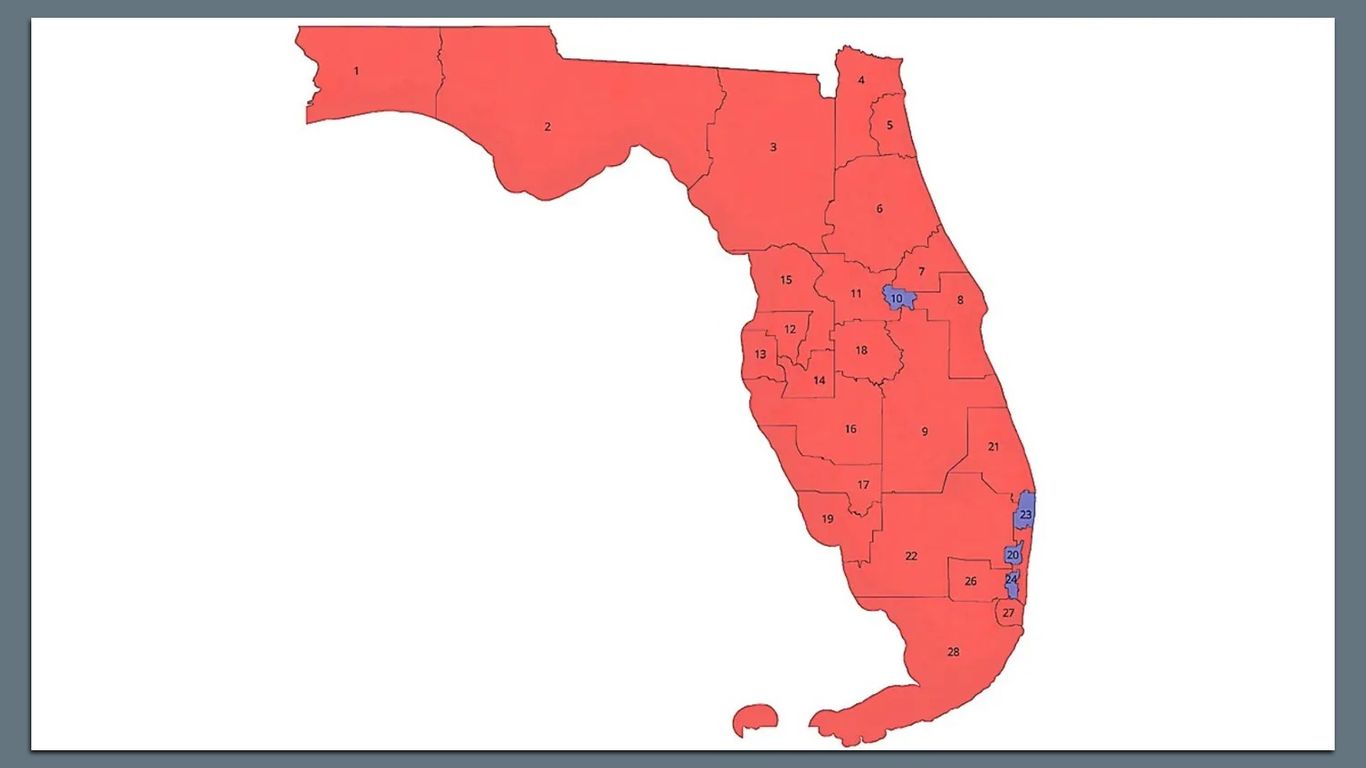
The map landed with the subtlety of a dropped anvil.
Florida Governor Ron DeSantis’s office didn’t exactly admit they were intentionally crafting districts to boost Republican seats when they sent reporters a new House map. But the move — color-coding districts by party — felt like a neon sign flashing “Gerrymander Ahead.” It’s a bald-faced maneuver that openly disregards the Florida constitution’s prohibition on intentionally drawing maps to benefit a party.
Normally, maps are a chaotic splash of lines, not a straightforward declaration of partisan intent. The usual approach involves a broad palette, a careful avoidance of stark red-and-blue demarcations that scream “we did this for politics.” DeSantis’s map, however, ditches that pretense entirely. It showed four blue districts for Democrats and a whopping 24 for Republicans, a significant bump from the 20 Republican seats in the current delegation.
Why Does This Matter for Florida Voters?
This isn’t just some abstract political chess match. This is about representation, about how your vote translates into power. The stakes are high because President Trump has been pushing red states to redraw their districts, aiming to shore up Republican control of Congress in November.
Florida’s constitution bans intentionally drawing maps to benefit either party, but President Trump has pushed red states to redraw their districts to improve Republicans’ chance of holding Congress in November.
DeSantis, it appears, is more than willing to play ball. He’s signaled a three-step plan, a legal strategy designed to buy time and delay court challenges, at least for a while. Democratic and liberal groups, predictably, are already gearing up to sue the moment the maps are officially passed. They see it for what it is: a partisan power grab.
More Than Just Lines on a Map
DeSantis didn’t stop at just pushing a new map. He’s been telling lawmakers to treat Florida’s Fair Districts Amendments — those protections approved by 63% of voters in 2010 — as if they were entirely void. His general counsel’s argument? That the amendments’ language, which mirrors the federal Voting Rights Act, is somehow unconstitutional, thereby nullifying everything within them.
These amendments weren’t just about preventing partisan gerrymandering; they also aimed to bar incumbent protection and require compact districts. Crucially, they offered protections for Black and Hispanic voters. Now, according to DeSantis’s legal team, those protections are on the chopping block.
Nick Stephanopoulos, a Harvard law professor and director of strategy at the school’s Election Law Clinic, voiced skepticism ahead of the map’s release. He noted that the state Supreme Court — heavily appointed by DeSantis himself — has already weakened the Fair Districts Amendments. It’s a court stacked with justices who seem predisposed to DeSantis’s arguments, making a truly independent review a steep uphill battle.
The Legal Chessboard
The Florida legislature is set to convene a special session to consider this new map, a move first reported by Fox News Digital. DeSantis’s official justification? He claims redistricting is necessary to reflect Florida’s evolving population. He’s cited grievances about how many seats his state received after the 2020 census, though under his proposed map, Florida still has 28 seats. The lines, however, are being redrawn, and dramatically so.
He’s also banking on the Supreme Court ruling that drawing districts based on race violates the 14th Amendment. It’s a legal tightrope walk, using a potential future ruling as a shield for present actions.
The analysis of this new map, even by outlets like Axios, paints a stark picture. It significantly improves the Republicans’ chances of weathering future political storms, especially after strong Democratic showings in recent special elections. Under the proposed map, Trump would have carried 24 districts, up from 20 currently. Even a 10-point swing towards Democrats from 2024 presidential levels would still see Republicans carrying 23 seats, nearly tying another.
This gambit, however, carries its own risks. Analysts suggest that this aggressive redistricting could dilute GOP dominance in some existing districts, leaving incumbent House members — Republican ones, no less — sweating bullets. Rep. María Elvira Salazar (R-Fla.) has already been sounding the alarm about slipping GOP support, a sentiment that perhaps adds another layer of anxiety to this high-stakes redistricting war.