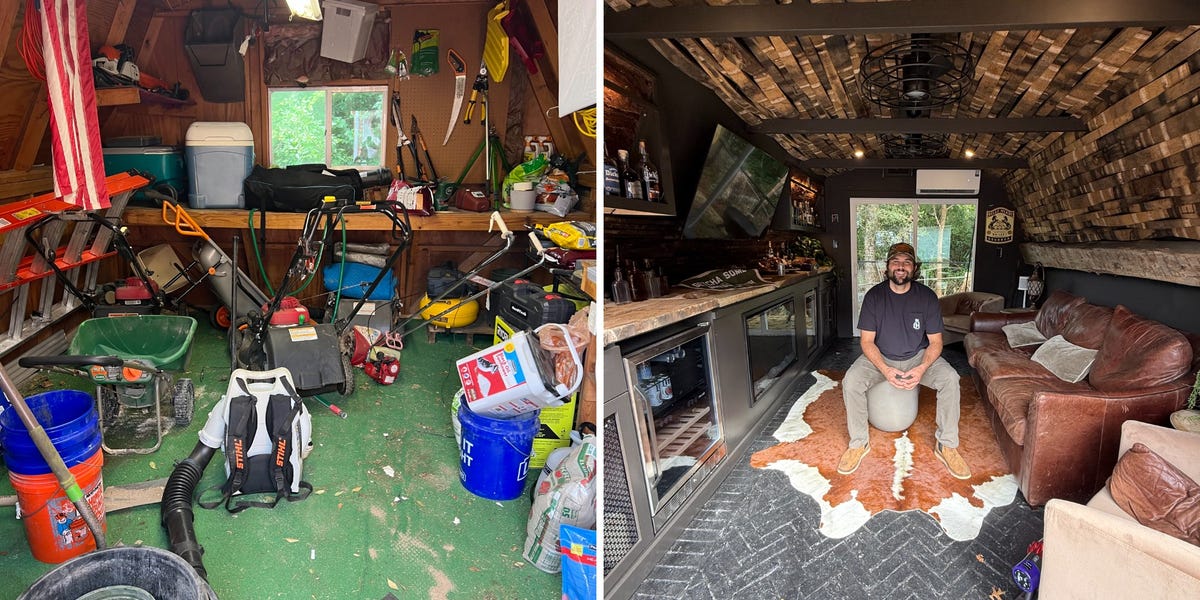
Look, the promise of a serene, perfectly curated sanctuary away from the chaos of life is a siren song for a lot of us. Especially for those of us who’ve spent years wading through the muck of tech PR, where every new gadget is hailed as the second coming and every minor software update is a “paradigm shift.” So, when stories pop up about someone transforming a mundane, forgotten space into a personal paradise, a little part of me — the part that’s still a sucker for a good before-and-after — leans in. We were expecting, I guess, another proof to disposable income and a desperate need for a quiet corner. What we got, though, with Tyler Graham’s shed renovation, is something a bit more… human. And cheaper.
This isn’t about a tech titan building a hyper-futuristic bunker. This is a 34-year-old content creator, Tyler Graham, looking at his disaster of a tool shed – the kind where lawnmower parts and forgotten marketing swag go to die – and thinking, “Why not make it awesome?” And the kicker? He did it for three grand. Three. Thousand. Dollars. That’s less than some people spend on a single designer couch, let alone an entire functional, stylish lounge.
The Shed That Wouldn’t Be Ignored
Graham’s shed, a 12-by-20-foot abyss, apparently housed the detritus of his DIY and tool-reviewing life. You know the drill. Stuff you use once, stuff you might use, and a whole lot of junk. It was, as he put it, “a disaster.” The original idea wasn’t even a whiskey den; it was a studio. But then the man cave idea took root, a vision of leather chairs, good lighting, and, yes, the aroma of fine tobacco and aged spirits. His wife, bless her heart, was apparently less than thrilled initially. I can’t blame her. Most people see a dilapidated shed and think “demolition,” not “designer lounge.” But Graham, bless his persistent soul, saw potential. Or maybe he just had a really good Pinterest board. Either way, he went for it.
Unleashing the Inner Builder (with Help from the Digital Gods)
The first step? Evacuation. Everything out. Things he wanted kept went to the garage, the rest was pawned off or donated. Classic decluttering 101. Then came the real fun: demolition and construction. This wasn’t a professional crew swooping in. This was Graham, armed with YouTube tutorials and, as he admits, “ChatGPT and YouTube.” Yes, you read that right. Apparently, the AI overlords are now helping people rip out drywall and install insulation. Who knew? It took him about a month of weekends, he says, to gut the place and then rebuild it. He learned to rewire, install lights, fans, and insulation. All on his own. That’s the part that gets me. Most folks would hire an electrician, a drywaller, a painter. Not Graham. He’s got the gumption.
“I knew how to take things apart, but I didn’t really know how to put them together. The shed was really built by ChatGPT and YouTube.”
The Barrel Illusion: Where the Magic (and Whiskey) Happens
And the result? It’s genuinely impressive. From the outside, it’s still just a shed. Maybe a few more plants, a bit of paint. But step inside, and it’s a different world. The real showstopper, though, isn’t the TV or the fireplace (though those are nice). It’s the walls and ceiling. He covered them in deconstructed whiskey barrels. Staves, bent and shaped, creating this complex, 3D woven effect. It’s rustic, it’s classy, and it smells like a distillery, apparently. A Nashville distillery even sent him 20 barrels. Twenty! Imagine that scent wafting down the block. Talk about making a statement. It’s a little slice of Tennessee history, literally built into his personal escape.
Who’s Actually Making Money Here? (Spoiler: Not the AdTech Giants)
This is where I perk up. The article mentions that a lot of the materials, including the brick flooring and fireplace, were promotional items. Gifts. Swag. Brands probably paid Graham to feature their products in his DIY videos, and in return, he got décor. The $3,000 he spent? Primarily on a used cowhide couch ($1,500) and wood for cabinetry ($1,500). That’s it. This wasn’t a multi-thousand-dollar splurge on custom everything. It was smart sourcing, clever bartering, and a whole lot of elbow grease. This is the antithesis of the typical Silicon Valley story, where venture capital flows like cheap champagne and valuations are based on potential, not tangible results. Here, the tangible result is a beautiful, functional space, built on a shoestring.
It makes you wonder about the real value proposition in our lives. Is it the latest AI widget that promises to optimize your hamster’s running schedule, or is it the ability to craft a physical space that brings genuine joy and relaxation? My money’s on the latter. And Graham, by documenting his journey, is also making money. He’s not just building a man cave; he’s building content. He’s proving that a well-executed DIY project, especially one with a unique hook like barrel staves, can capture an audience. Who’s profiting? Graham, definitely. The brands that got exposure, presumably. And us, the audience, who get to see something inspiring and, dare I say, aspirational without needing a billionaire’s bank account.
So, What’s the Real Takeaway?
Here’s the thing: we’re bombarded with the narrative of needing the newest, the biggest, the most expensive to achieve anything worthwhile. Graham’s shed project flips that script. It’s a reminder that creativity, resourcefulness, and a willingness to learn (even from a chatbot) can yield extraordinary results on a modest budget. It’s not about the $3,000 spent; it’s about the value derived. It’s about transforming a neglected storage space into a hub for relaxation and family time – he apparently uses it as a Disney movie theater with his son more than a whiskey lounge, which is, frankly, adorable. It’s proof that sometimes, the most impressive transformations are the ones that are most grounded in reality.
🧬 Related Insights
- Read more: AI for Marketers: Is Your Org Ready?
- Read more: First-Party Data Strategy: Building an Advertising Moat Without Cookies
Frequently Asked Questions
What did Tyler Graham use his shed for before renovating it?
Before the renovation, Tyler Graham used his tool shed as a storage space for lawn tools and equipment he reviewed for his content creation channels.
How much did Tyler Graham spend on his man cave renovation?
Tyler Graham spent approximately $3,000 on his man cave renovation, with a significant portion going towards a used couch and wood for cabinetry.
What was the most unique feature of Graham’s man cave?
The most unique feature of Graham’s man cave is its walls and ceiling, which are covered with deconstructed whiskey barrel staves creating a 3D woven effect.