70.6% of AI traffic lands as ‘Direct’ in GA4. Think about that for a second. It’s a number that screams ‘mystery’ in the world of ad tech measurement, a ghost in the machine of performance marketing. We’re swimming in AI visibility dashboards, agencies are cashing checks, and CFOs are starting to tap their pens, muttering that age-old question: ‘Where’s the revenue?’ This isn’t just about seeing impressions anymore; it’s about proving the dollars.
Look, everyone’s excited about AI. It’s a platform shift, the kind that redraws the entire map of how we do business online. But right now, measuring its impact, especially in Local SEO or GEO performance, feels like trying to catch lightning in a bottle. We can see the flashes, but can we bottle that power and sell it?
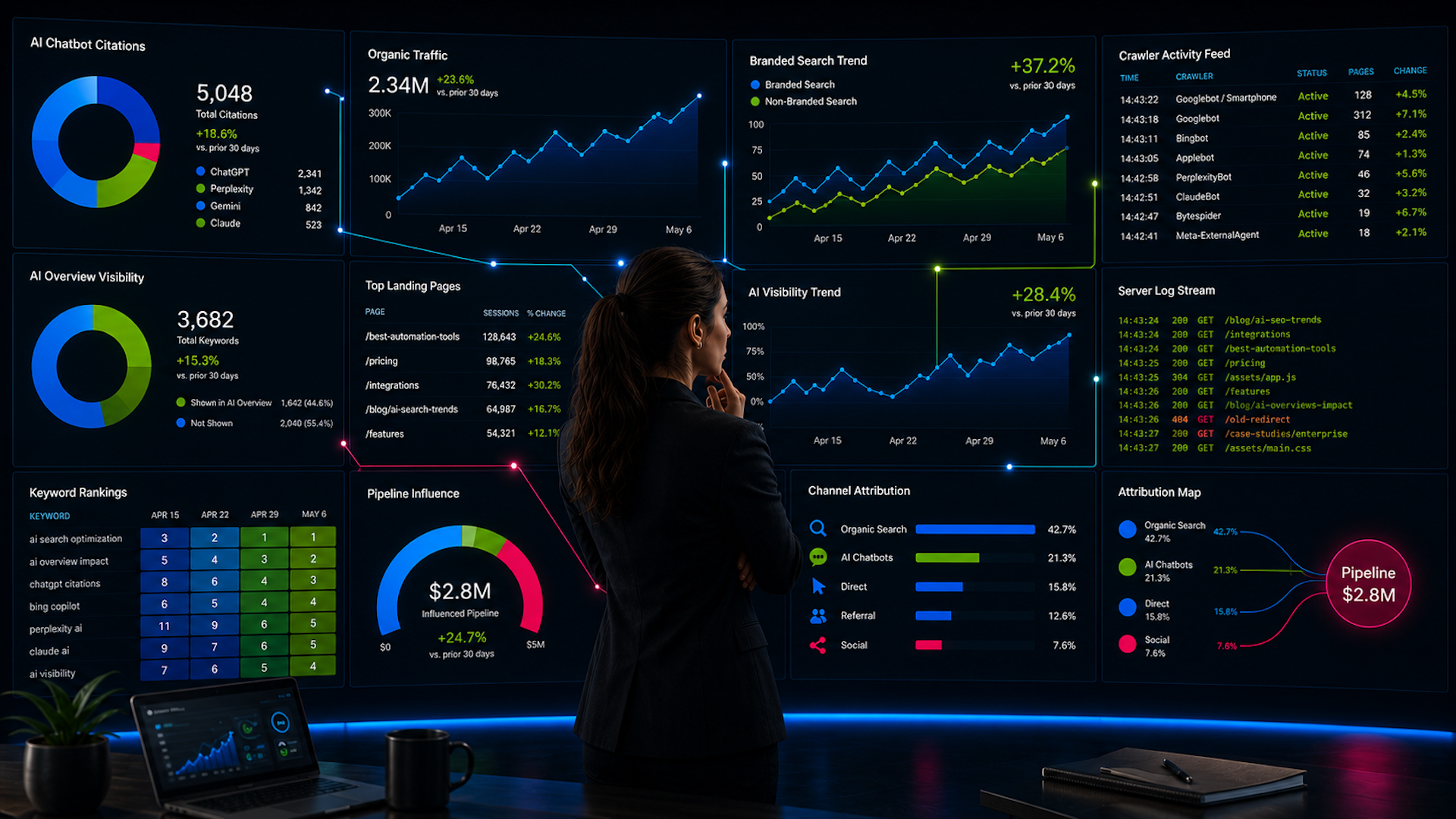
Agencies are quick to slap AI visibility metrics onto retainers – citation share, presence rate, AI Overview appearance counts. These look great on a slide deck, don’t they? Impressive numbers. But for most of the outfits selling these metrics, they’re about as connected to actual pipelines as a flip phone is to the metaverse. The truth is, the AI revolution is outrunning our measurement capabilities, leaving us with impressive-sounding data that often doesn’t translate into defensible revenue.
What’s needed is a more strong approach. The following is a five-layer framework for measuring GEO performance that you can actually defend. It’s not about a perfect, closed loop – the tech isn’t there yet. It’s about triangulation: using multiple, imperfect signals that, when they move in concert, paint a picture of something undeniably real.
Layer 1: The Direct Hit (When It’s Visible)
This is your bedrock. It’s the one part of the equation most agencies are already tracking, and it remains vital. We’re talking about the human who saw an AI answer, clicked on your link, and landed on your site. That’s a clean, undeniable signal. Capture it. Cherish it.
The problem? GA4 often flubs this. Referrers from AI tools? They’re often stripped out or shoved into the amorphous ‘Direct’ bucket. So, the sessions you can clearly see are just a sliver of reality. Loamly’s analysis back in early 2026 looked at over 446,000 visits and found that a staggering 70.6% of AI traffic arrived in GA4 labeled simply as ‘Direct.’
And even with a perfect setup, you’re only seeing the human clicks. Anything an AI does on your behalf – browsing, fetching, summarizing without that explicit click – is a black hole for GA4. Plus, that human click rate? It’s shrinking. Agentic browsers are making it worse. ChatGPT Atlas, for instance, has been seen spoofing the user-agent string as ‘Chrome 141,’ making it utterly indistinguishable from a regular Chrome session at the HTTP level. Other agentic browsers, like Perplexity Comet, present identical challenges. The traffic looks human, but the AI is the engine.
So, yes, build Layer 1. It’s your most direct signal. But don’t kid yourself into thinking it’s the whole iceberg. It’s the glistening tip, and the rest is rapidly sinking below the surface.
Pro-Tips for Layer 1: - Rejigger your GA4 channel groupings. Specifically capture referrers from known AI domains: chatgpt.com, chat.openai.com, perplexity.ai, gemini.google.com, copilot.microsoft.com, and claude.ai. - Implement a custom dimension to capture the full user agent string. Every bit of detail matters here.
Layer 2: Listening to Your Logs (The Unseen Data)
Here’s where we hit a massive, ignored goldmine: your website’s access logs. Almost nobody is digging into these for AI activity, yet the data is sitting there, generated automatically on every server. Agencies I speak with? They’re not parsing this. It’s a free, rich signal source being left to rot.
There are three distinct types of bots showing up in your logs, and they tell very different stories. Mixing them up is a recipe for bad analysis.
Training & Model-Improvement Crawlers: Think GPTBot, ClaudeBot, anthropic-ai, CCBot, Bytespider. These are signals of infrastructure readiness, not demand. Their presence means AI models are interested in your content for training purposes. It’s good to know you’re not being ignored at the foundational layer, but it tells you nothing about whether anyone is asking questions about your client today.
Search & Indexing Crawlers: These are your OAI-SearchBot, Claude-SearchBot, PerplexityBot, DuckAssistBot. They are indexing your content so it can show up in AI search features. These are leading indicators for eligibility for citation – proof that the AI sees you and is preparing to potentially use you.
User-Triggered Fetchers: Ah, the closest thing to real-time demand we have. When you see ChatGPT-User, Claude-User, Perplexity-User, MistralAI-User, it means a user actually prompted an AI, and the model needed to pull live information to answer. This is it – the direct request.
A quick note on Google: User agents like Google-Agent (powering Project Mariner) and Google-NotebookLM are AI-specific. However, Google’s AI Mode and AI Overviews also lean on their broader crawling infrastructure. In logs, untangling classic Search crawling from AI-specific retrieval can be messy. Track these in aggregate, and be honest about the precision (or lack thereof).
The sheer scale of what’s missed by ignoring this layer is mind-boggling. Cloudflare data from June 2025 showed OpenAI’s crawl-to-referral ratio was a jaw-dropping 1,700:1, and Anthropic’s was 73,000:1! Compare that to Google’s 14:1. Their year-end review highlighted Anthropic’s ratio fluctuating wildly, sometimes between 25,000:1 and 100,000:1, with OpenAI hitting 3,700:1. SEOmator’s Q1 2026 analysis of Cloudflare data further underscores this point.
This isn’t just noise; it’s a massive signal stream crying out for attention. Treating your access logs as a primary source for AI performance measurement is no longer optional—it’s essential.