This isn’t about a new software update. This is about a seismic shift in how we build the digital infrastructure that underpins our lives. When the lights go out, or the grid buckles, who’s actually ready? That’s the profound question Salesforce Architects are wrestling with, not in abstract theory, but in the gritty, high-stakes reality of designing systems that can actually do something when the unthinkable happens. This isn’t just about managing an incident; it’s about building a resilience engine.
And here’s the kicker: AI is the hidden accelerant, the silent architect behind this entire paradigm. We’re moving beyond just automating tasks to creating systems that can reason through chaos, adapt on the fly, and communicate with precision when everything else is breaking down. Think of it like this: before, we built sturdy brick houses. Now, we’re learning to engineer self-healing, shape-shifting structures that can absorb a shockwave and reform. That’s the future they’re building, and it’s wild.
The Architect’s Compass: What, How, Why
The team at Salesforce has codified a brilliant framework for tackling these monstrous challenges. It’s a three-pronged attack: What, How, and Why. It sounds deceptively simple, almost like a management consultant’s playbook, but when you see it in action, especially when the stakes are sky-high, its power becomes blindingly clear. It’s about stripping away the jargon, drilling down to the core problem, and then mapping a clear, justifiable path forward. This isn’t just about solving a problem; it’s about understanding the problem so deeply that the solution becomes almost inevitable.
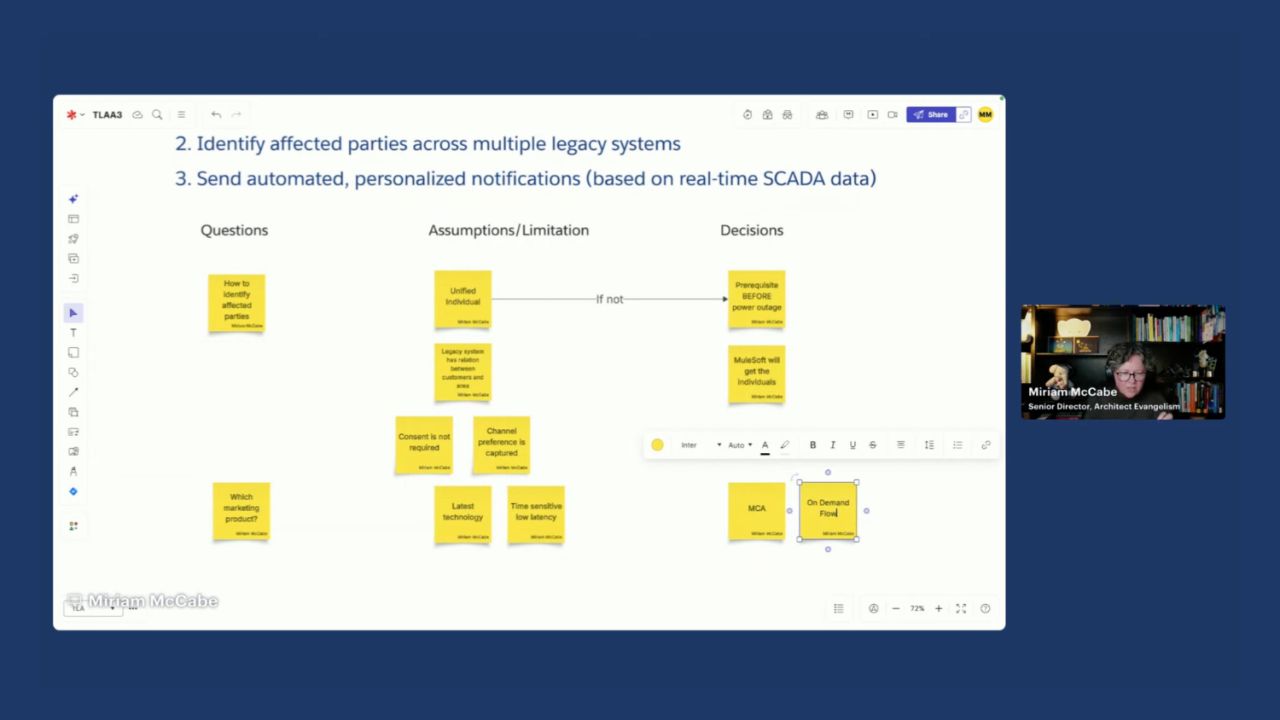
What: This is where the raw requirements, the panicked calls from the field, get translated into concise, actionable High-Level Requirements (HLRs). It’s like taking a scream and turning it into a specific, targeted instruction. For instance, instead of a vague “Deal with the power outage!” you get crisp directives: “Detect unplanned outages and notify Salesforce instantly.” Or, critically, “Identify affected parties across multiple legacy systems.” This is the bedrock, the non-negotiable starting point. Get this wrong, and you’re building on sand.
By highlighting key phrases, we strip away the business narrative to ensure we are solving the right problems from the start.
How: Now, this is where the rubber meets the road, or rather, where the code meets the chaos. You take those HLRs and you start architecting. You’re throwing technologies at the wall — MuleSoft for low-latency events, Data 360 for unifying individual data — but critically, you’re doing it with a clear target. Each technical choice is a direct response to an HLR. Assumptions are surfaced, questions are logged, and decisions are etched into the blueprint. This isn’t a free-for-all; it’s a calculated, deliberate dance with complexity, especially in a multi-cloud environment where you’re juggling systems like a seasoned circus performer. The goal? To route work to the right teams and create a proactive, personalized multi-channel service experience, even when the very channels themselves are under duress.
Why: This is the guardian of your sanity, and the sanity of your future self. Every decision, every trade-off, every moment of brilliance (or admitted uncertainty) gets documented. This is the Architectural Decision Record (ADR), a time capsule of your reasoning. It’s your defense against Monday-morning quarterbacking and your roadmap for the next iteration. Why did we choose this integration pattern? Why did we make this assumption about data unification? This is where the discipline lies, transforming a reactive fix into a strategic build.
The AI Nexus: Beyond Automation to Autonomy
The true magic here, the thing that makes my futurist heart sing, is how AI is woven into the very fabric of this incident journey. It’s not just a tool you use; it’s an embedded intelligence. When we talk about identifying affected parties across multiple legacy systems, AI’s pattern recognition and data fusion capabilities are what make that even possible at scale. When we talk about sending automated, personalized notifications based on real-time SCADA data, AI is the engine that can interpret that raw data and tailor the message to the individual’s context.
This isn’t just about speed; it’s about contextual awareness. Imagine an outage hits a city. AI doesn’t just trigger a generic alert. It can parse the SCADA data, cross-reference it with individual customer profiles, understand which services are impacted (power, water, communications), and then craft a message that’s not only personalized but also anticipatory. “Your power is out, and we anticipate it will be restored by 3 PM. Your connected smart thermostat will remain functional on backup battery for 4 hours. For updates, follow this link…” That’s not just good customer service; that’s an intelligent system performing under extreme pressure.
Why Does This Matter for Real People?
Look, we’re not all Salesforce architects. But we are all people who rely on these complex digital systems. When the power goes out, you don’t want a system that just logs an incident. You want a system that knows you’re impacted, understands what that means for you, and communicates with you intelligently. This architectural approach, powered by AI, is what makes that possible. It’s the difference between being left in the dark, wondering what’s happening, and being kept informed, empowered, and reassured that a sophisticated engine is working to restore normalcy. This is the human dividend of intelligent, resilient systems.
The Unifying Force: Data as the Oracle
The core of this whole complex dance, particularly in a multi-cloud, multi-system landscape, is data. The ability to unify individual data across disparate legacy systems is presented as a critical prerequisite. Without a concept of a “Unified Individual,” you’re drowning in fragmented information. AI, with its ability to process, cleanse, and correlate vast datasets, becomes the linchpin. It’s the difference between a detective with scattered clues and a detective who can instantly see the entire crime scene, interconnected and comprehensible. This unification isn’t just about good CRM; it’s about building the foundational understanding needed to respond effectively to any crisis.
The Future of Resilience
What Salesforce is outlining here is more than just a design pattern. It’s a blueprint for a future where our digital infrastructure isn’t just built to withstand shocks, but to learn from them. The What, How, Why approach, infused with AI’s predictive and adaptive capabilities, is turning incident management from a reactive fire drill into a proactive, intelligent guardian. This is the fundamental platform shift AI enables: the move from brittle, command-and-control systems to fluid, intelligent ecosystems that can sense, adapt, and communicate their way through any storm. It’s exciting. It’s necessary. And frankly, it’s about time.
🧬 Related Insights
- Read more: Just Dance 2026 DOOH: Programmatic Powers Global Retail Push
- Read more: TiVo Ads: Owning the TV Home Screen’s First 5 Seconds
Frequently Asked Questions
What is a high-scale multi-cloud incident journey? A high-scale multi-cloud incident journey refers to the process and architecture designed to manage significant disruptions (incidents) that affect systems running across multiple cloud platforms, demanding rapid, coordinated responses.
How does AI help in incident management? AI enhances incident management by automating detection and analysis of issues, predicting potential impacts, personalizing notifications to affected parties, and routing tasks efficiently, thereby improving response times and overall effectiveness.
Is the What, How, Why approach new? While the fundamental principles of defining requirements (What), planning solutions (How), and documenting rationale (Why) are not new, Salesforce’s application of this structured methodology to complex, AI-infused, multi-cloud incident journeys represents a modern, strong framework for architectural decision-making in high-stakes scenarios.