So, Fox held its upfront. Big deal, right? They trotted out the usual suspects: live sports, news, entertainment, and this shiny new thing called Tubi. And sprinkled throughout, like glitter on a toddler’s craft project, was AI. Lots of it. But here’s the question that always hovers in rooms like these, the one the suits don’t want you to ask: who’s actually making money here?
Fox’s big tech splash was Fox Fan OS, an “agentic AI-native media operating system.” Melody Hildebrandt, the CTO, talked about AI inference running against video second-by-second. Extracting ‘topic, talent, mood, and vibes.’ Sounds fancy. They’re allegedly using this to figure out what resonates with fans and then – and this is where the money part should come in – plugging brands directly into these insights via Fox AdStudio.
They claim this AdStudio offers a ‘converged audience graph’ and a ‘contextual engine for scene-level targeting.’ Look, for two decades, I’ve seen ‘converged audience graphs’ and ‘contextual engines’ come and go. Most of them end up being glorified spreadsheets with expensive dashboards. The ability to ‘plug directly into brands’ own AI agents’ sounds promising, but let’s be honest, most brand AI agents are still trying to figure out how to write an email without sounding like a robot reading a dictionary.
And then there’s Tubi. Apparently, it’s now big enough to be a star all on its own. 100 million monthly users, 10 billion hours watched. They even claim it ranks fourth among streamers for reaching high-income cord-cutters, beating out Disney+ and Paramount. High-income cord-cutters? That’s the gold rush, isn’t it? Tubi’s touting incremental reach and new ad formats – pause-to-participate units, shoppable in-scene placements. They even threw out some performance lifts: 21% for retail, 37% for QSR. These numbers are fine, but are they new? Or just the same old story with a fresh coat of paint and a slightly more sophisticated attribution model?
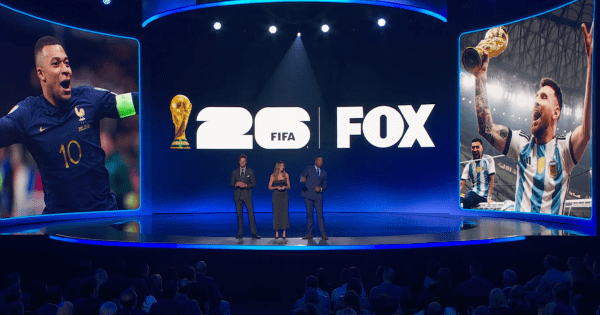
The World Cup, naturally, took center stage. Because nothing screams ‘buy our ad slots’ like a global sporting event. 70 matches on Fox, 34 on FS1, all 104 on Fox One. Then they paraded out James Corden, Tom Brady, Gronk, Erin Andrews, Derek Jeter, David Ortiz, Alex Rodriguez… you get the picture. Sports, sports, sports.
Is Fox’s AI Just Another Buzzword Machine?
This is where my skepticism really kicks in. Fox is trying to pitch a streamlined approach – ‘first principles,’ they call it. No more ‘scale just for scale’s sake,’ according to CEO Lachlan Murdoch. That’s a good line. It sounds responsible, it sounds like they’ve learned something. But then they roll out ‘Fox Fan OS’ and ‘Fox AdStudio.’ It feels like they’re trying to sound technologically advanced without fundamentally changing the ad-selling game. For years, the industry has been drowning in jargon. ‘First principles’ is a good anchor, but does stuffing AI into every corner of the operation actually simplify things for advertisers, or does it just create a more complex, less transparent system where the only people winning are the tech vendors and the consultants who set it all up?
They’re claiming over 1,000 advertiser campaigns measured through this platform. Double-digit lifts. Great. But the crucial question remains: is this AdStudio truly differentiated, or is it just the industry’s version of ‘table stakes’ now? Everyone’s got an AI story. Everyone’s measuring outcomes. What makes Fox’s offering stand out from NBCUniversal’s or Disney’s more established, and frankly, more proven, AI-driven pitches? The real test isn’t the slick presentation; it’s whether advertisers open their wallets with genuine confidence, not just because it’s the ‘next big thing.’
For a marketplace where buyers are increasingly skeptical of buzzwords and fragmentation, the tidy framing is meant to read as a competitive advantage.
The World Cup inventory clearing out? Predictable. That’s always the biggest draw. But the long game for Fox, and indeed for any broadcaster trying to navigate this increasingly fractured media landscape, isn’t just about selling eyeballs for the next big event. It’s about building a sustainable, transparent, and profitable ad-tech ecosystem. Right now, with the AI hype train at full throttle, it’s easy to get lost. I’m waiting for the concrete proof that this AI isn’t just a shiny object designed to justify higher CPMs, but a genuine tool that delivers measurable, incremental value to advertisers, and by extension, to Fox’s bottom line without a massive increase in operational complexity.
What’s the Real ROI on Fox’s AI Push?
This is the million-dollar question, isn’t it? Everyone’s talking about AI, but few can clearly articulate the return on investment beyond vague promises of better targeting and more engaged audiences. Fox is pushing its AdStudio as a way to measure performance and offer a more integrated experience. But without seeing the granular data and understanding the cost structure behind these AI tools, it’s hard to gauge the true ROI. Is the lift in retail sales worth the premium price tag for these AI-enhanced ad slots? Or are advertisers just paying more for the same underlying audience, now dressed up in AI-generated insights?
Fox Creative Studios, a new IP-development arm, sounds intriguing. Partnering with creators, including Gordon Ramsay and Johnny Knoxville. That’s more about content development and less about ad tech, but it hints at a broader strategy. They’re trying to build an ecosystem. The question is whether that ecosystem is truly innovative or just another iteration of familiar media play. The network’s own Fox News boasting about outgrowing the cable label and raking in website visitors and YouTube views further complicates the picture, suggesting a multi-pronged strategy that might or might not coalesce into a cohesive ad-buying proposition.
Ultimately, Fox’s upfront was a carefully curated message. Streamlined. Focused. AI-enhanced. But as a seasoned observer, I’m still looking for the receipts. Where’s the undeniable proof that this AI isn’t just a trend they’re chasing, but a fundamental improvement in how advertising gets done and, more importantly, how it gets paid for. The market will decide, of course. But I’ll be watching with a healthy dose of cynicism.